1

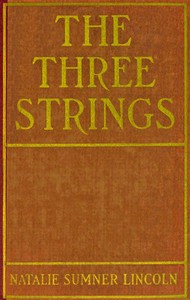
The three strings — A Closer Reading
(0 User reviews)
1129
Project Gutenberg
2024
Not confirmed
Detective and mystery stories; Murder -- Investigation -- Fiction; Washington (D.C.) -- Fiction; Chess -- Fiction
Readers of public-domain and historical texts
Project Gutenberg digital edition
en
Edition facts
Words
68,134
Reading time
297 min
Text sections
29
For The three strings — A Closer Reading, the stored edition analysis reports 68,134 words, 4 hr 57 min estimated reading time, and 29 detected text sections.
The text analysis averages about 14.3 words per sentence, while the detected sections provide another way to judge how the source is divided.
Project Gutenberg metadata also associates the work with “Detective and mystery stories,” connecting these edition facts with the source record’s subject description.
Source:
Project Gutenberg record #73597
This editorial note examines how the opening, middle, and later excerpts of Natalie Sumner Lincoln's 1918 mystery 'The Three Strings' guide a first reading, focusing on the chess-themed chapter titles, the use of a Maxim silencer as a clue, and the Washington, D.C. setting.
Editorial Edition Score
4.9/5
★★★★★
★★★★★
Calculated from edition completeness, EPUB availability, text structure and catalogue metadata. Not a user rating.
How this score is calculated
- Description quality20 pts
- Title & short description10 pts
- Source metadata20 pts
- Text length15 pts
- Chapters / structure15 pts
- EPUB file integrity20 pts
Total of 100 points, scaled to a 2.5-5.0 range. Editions with an empty description or a missing EPUB file are not scored.
Edition quality
Read the Text
th a joyful exclamation Evelyn rose to her feet--the servants had come at last. As she started for the hall door she came face to face with the room-bell register--the indicator moved slowly downward and stopped at the printed word: “Library.”
Evelyn stared at the indicator in perplexity. Pshaw! the register was out of order; it was the front door bell which had rung. Stopping long enough to turn off the gas burning in the range she hastened upstairs to the front door, only to find the vestibule empty. She stepped out on the doorstep and glanced up and down, but except for a motor vanishing around the corner, the street was deserted.
Considerably perturbed Evelyn reëntered the house, and it was some seconds before she mounted the staircase to the second floor. Her lagging footsteps were accelerated by the sudden thought that perhaps her step-father had returned and gone straight to his room and, supposing from the opened windows that the servants were downstairs, had rung for the butler. He always carried his latch-key; but her mother had mailed her his latch-key!
Evelyn’s hand fell from the portières to her side and she drew back, then, suppressing her growing nervousness, she parted the portières and stepped into the library. She had advanced half across the room before she became aware that a stranger sat half facing her near the great stone fireplace.
Evelyn retreated precipitously; then, gathering her wits, she demanded a trifle breathlessly:
“How did you get here?”
Her question remained unanswered; and anger conquering her fright, Evelyn stepped up to the chair and for the first time obtained a full view of the stranger’s ashen face and wide-staring eyes. Instinctively she bent nearer and her hand sought his pulseless wrist; its icy chill struck her with terror. With one horrified look into the dead eyes she fled from the room.
EVELYN never knew how she reached the front door, but as she dashed out into the vestibule she almost fell into the arms of a tall neatly dressed woman standing on the doorstep. For a breathless second she clung to the newcomer in silence.
“Matilda!” Only in moments of stress did Evelyn ever address her mother’s housekeeper by her first name. “Thank God you are here!”
Mrs. Ward gazed at her in alarm. “What’s wrong, Miss Evelyn?” she asked. “Come inside, Miss,” coaxingly, growing conscious that Evelyn was swaying upon her feet. Supporting the half fainting girl, she led her into the billiard room which opened from the hall to the right of the front door. Once in the room Evelyn collapsed on the nearest chair.
“Oh, don’t go,” she begged as Mrs. Ward stepped toward the hall. “Don’t leave me.”
“Only for a moment, Miss; I left my bag outside the house,” and Mrs. Ward, disentangling her skirt from Evelyn’s clutching fingers, disappeared into the hall to return shortly with a glass of water in one hand and her bag in the other. She dropped the latter on Evelyn’s trunk as she entered the room.
“Take a sip of water, Miss Evelyn,” she said, retaining her hold of the glass as Evelyn’s attempts to take it in her shaking hand proved futile. “Are Jones and the cook here?”
“No.” Evelyn was only equal to monosyllables.
“They haven’t come!” Mrs. Ward looked shocked. “All the servants were to leave Atlantic City this morning on the first train. No wonder you were frightened, Miss Evelyn, all alone in this big house.”
“But I was not alone.” Evelyn pushed aside the empty glass; she felt refreshed by the cold water and the presence of Mrs. Ward restored her to some degree of composure. “There’s a dead man upstairs!”
The glass slipped from Mrs. Ward’s hand and broke on the highly polished floor.
“Are you mad?” Mrs. Ward spoke more roughly than she realized, and Evelyn’s angry flush caused her to modify her tone to its customary civility. “Are you in earnest, Miss Evelyn?” Evelyn nodded vigorously, and Mrs. Ward’s comely face paled. “It’s--It’s not Mr. Burnham?”
“No; I have never seen the man before.”
Mrs. Ward stared blankly at Evelyn, then roused herself. “Hadn’t I better go and investigate?” she asked. “You may be mistaken, Miss; perhaps the man’s only asleep.”
The first chapter, titled 'The First Move,' immediately establishes a chess motif that runs through the book's chapter headings—'Complications,' 'Developments,' 'Unmasked'—suggesting the murder investigation is a strategic game. Evelyn Preston's return to a hot, closed house in Washington, D.C., sets a stifling atmosphere that contrasts with the intellectual coolness of chess. The frontispiece caption, 'Hurry, hurry,' she gasped, as a white-robed figure stepped inside her room, hints at a nocturnal intrusion, but the excerpts do not reveal the figure's identity.
Chess as Structural Metaphor
The chapter titles—'The First Move,' 'Complications,' 'Developments,' 'The Fifth Man,' 'Unmasked'—are drawn from chess terminology, framing the plot as a series of strategic plays. The acknowledgment thanks a chess expert for assistance with a chess problem, indicating that the game's logic may underpin the mystery's solution. However, the excerpts do not show any actual chess play; the metaphor is confined to the table of contents. Readers should watch for whether the chess structure extends to character actions or remains a decorative framework.
The Maxim Silencer as a Telling Detail
In a key excerpt, Maynard discovers that La Montagne's revolver is equipped with a Maxim silencer—a device 'forbidden by law.' This detail becomes a crucial clue, as the shooter used a similar silencer. The passage highlights the tension between legal prohibition and practical use, with La Montagne dismissively noting, 'Laws are broken daily in America.' The silencer is not merely a plot device but a marker of character: La Montagne's possession of an illegal accessory aligns with his outsider status as a Frenchman in Washington, and his marksmanship medal suggests precision. The excerpts do not reveal whether this clue leads to his guilt or innocence.
Washington, D.C. as a Character
The story is set in Washington, D.C., during a late September heat wave, which Evelyn finds 'refreshing' after the glare of asphalt. This specific seasonal detail grounds the mystery in a real, oppressive environment. The setting is not just backdrop; it influences action—the balcony access, the open French windows, the corridor where La Montagne is found. The city's political and social milieu is hinted at through characters like Burnham, who opposes La Montagne's engagement to Evelyn, but the excerpts do not elaborate on Washington's role beyond providing a stage for the crime.
Unreliable Accusations and Shifting Suspicions
The middle excerpts present a web of accusations: Burnham claims La Montagne tried to kill him, but Maynard points out that Burnham 'appears to hate' La Montagne, suggesting bias. La Montagne insists their intercourse has been 'little but friendly,' yet he admits knowing of Burnham's opposition to his engagement. The narrative withholds judgment, leaving readers to weigh each character's word. The taxi-driver's potential alibi is mentioned but unconfirmed in the excerpts. This ambiguity forces readers to question every statement, a hallmark of the detective genre that the novel employs from its early chapters.
Readers approaching The Three Strings for the first time should pay close attention to the chess chapter titles as potential signposts, the Maxim silencer as a physical clue with legal and personal implications, and the Washington setting as more than mere location. The excerpts leave many questions open—who is the white-robed figure, and is La Montagne guilty or framed? The novel's structure rewards careful observation of details that may reappear later as keys to the puzzle.
I finished rereading The Three Strings the other evening, and found myself drifting back to that other tale set in a quiet city room, where time itself felt like the real suspect. There’s something about those old Washington mysteries—the way a silenced gunshot and a ticking clock share a hush. It made me reach for Murder by the clock — Story, Setting & Ideas again, just to sit with that strange, lovely stillness.
There are no reviews for this eBook.
There are no comments for this eBook.
Reader reflection
How will you remember this book?
Save your reaction, strongest insight, and memorable passage.
Your progress
0
/
10
2
Did this book hold your interest?
3
Would you recommend this book to another reader?
4
How much effort did this book require?
5
Did this book create an emotional response?
6
Did it raise ideas you would like to talk about?
7
Which aspect of the book did you value most?
8
How would you describe its reading pace?
9
What changed or sharpened your thinking?
10