1

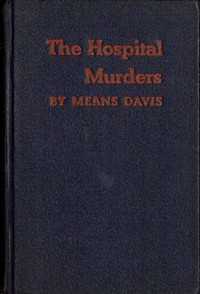
The Hospital Murders — Context and Discussion
(0 User reviews)
672
Project Gutenberg
2017
Not confirmed
Detective and mystery stories; Murder -- Investigation -- Fiction; Private investigators -- Fiction; Medical personnel -- Fiction
Readers of public-domain and historical texts
Project Gutenberg digital edition
en
Edition facts
Words
68,367
Reading time
298 min
Text sections
10
The source record for The Hospital Murders — Context and Discussion measures this digital text at 68,367 words, 4 hr 58 min estimated reading time, and 10 detected text sections.
The text analysis averages about 11.4 words per sentence, while the detected sections provide another way to judge how the source is divided.
Project Gutenberg metadata also associates the work with “Detective and mystery stories,” connecting these edition facts with the source record’s subject description.
Source:
Project Gutenberg record #54445
An editorial note on Means Davis's 1934 crime novel, focusing on its brisk dialogue, hospital setting, and the narrative's accelerating pace as the body count rises.
Editorial Edition Score
4.8/5
★★★★★
★★★★★
Calculated from edition completeness, EPUB availability, text structure and catalogue metadata. Not a user rating.
How this score is calculated
- Description quality20 pts
- Title & short description10 pts
- Source metadata20 pts
- Text length15 pts
- Chapters / structure15 pts
- EPUB file integrity20 pts
Total of 100 points, scaled to a 2.5-5.0 range. Editions with an empty description or a missing EPUB file are not scored.
Edition quality
Read the Text
ne gave the Sleeping Beauty a pouty stare. There would be no decompression. By now the blood sugars would have increased to six. They must be done before supper, too!
The nurse followed Dr. Sterling onto the wards and he began his rounds and gave his instructions. At the patient in Bed 11 he stared carefully and turning, snapped:
“How was that thyroid’s basal?”
After her response he walked over to the bed, took the woman’s pulse and said very absently:
“You are doing splendidly. Keep it up!”
The nurse followed him to the elevator and begged:
“You _are going_ by the Admitting Office, Doctor? Will you return the blanks, or shall I keep them until tomorrow?”
He scowled and his black eyebrows met. Then he pushed the elevator button with precision.
“Fill out the details, hair, eyes, that bunk, and give them to me tomorrow. The Admitting Office can wait ... for once.... I’ll telephone over the important particulars. ’Night!”
His “’Night!” was another way of saying, “That’s all! And no more questions, madam!”
The elevator began ascending and the girl operator asked timidly:
“What floor, Doctor?”
Cub Sterling appraised her vacantly:
The girl’s voice quavered:
When the elevator halted, he quickly raised his head:
“By the way, how’s your cold?”
“Haven’t you a cold?” he growled.
“No, Dr. Sterling. Thank you. I haven’t.”
“You’re welcome. Other operator, I guess.”
He stepped from the elevator and began his rounds. A whole avalanche of nurses galloped down the hall and he realized it must be time for the shift. He squinted at his watch and saw that it was almost seven.
“Damn it to hell!” he muttered.
Hot hash was bad enough. By now it would be slime. Better finish the rounds and eat at Otto’s. Herbie’s hands had messed things up! Damned old spider! His memory was focusing upon the girl when the floor interne hurried forward and began to report.
One hour and a half later Dr. Ethridge Sterling, Junior, tilted back in the swivel chair in his private office. His left heel held the edge of the seat, the telephone was balanced upon his left knee, the receiver wedged between his left shoulder and ear. His eyebrows were parted; he had just given his pants a comforting jerk. His mouth twitched occasionally; in his free hands he held a copy of “The Love Books of Ovid” and his eyes measured a familiar illustration. He decided that the legs weren’t up to hers. His father’s voice centered his attention, again.
“Your thyroid, sir. Did a remarkable basal. Pulse is down to 110. Lowest ... so far....”
“Fine! I’ll operate tomorrow if you advise. Drop around later and give her a final once-over. Be there in half an hour.”
“But Father, I’m hungry ... I missed....”
“All right. All right! You always were! Go get your supper. I don’t need you dancing attendance on me! Still know an operative patient when I see one. Don’t interrupt me! You talk too much! Always did! Goodnight, son!”
His gruff affection blacked out the illustration. Cub placed his right foot against the center drawer of his desk and began wondering what he wanted to eat. Shad roe? Lamb chops? Roast beef?
His telephone bell jangled sharply:
He propped open a recent copy of the _New Yorker_ and read four passable cartoons, turned the page, then lifted the receiver.
Dr. Barton’s voice begged:
“Yes, sir. Yes, Dr. Barton. Been trying to get you all evening, sir. Think she’s all right. Pull through. Can’t tell for a certainty yet. Mostly shock. What’s that? Aw, she’s average. Kinda tinselly. By the way, better say none of those paper people can see her for a week. No beaus and no flowers. Righto! Not at all! See you tomorrow, sir.”
Cub replaced the receiver, rose, straightened his tie, changed to a blue serge coat, tore three wedding invitations on his desk to shreds, slung the shreds into the waste basket, slammed the door and slouched up the stairs, whistling.
The jingling of a telephone bell followed him. That’s why he whistled.
Five minutes later, the woman in the Admitting Office wrote Thursday, May 12th for the fourth time, and Sophie Merriweather, Newark, N. J., for the tenth time, and Cub Sterling barged into Weber’s deserted restaurant and said, pathetically:
Then he lifted the hose of a talking tube and ordered:
“Three-minut-steak-two-vrench-vrys-asparaggus-on-toas-celler-y- an’- ollivs- VRIGH-TER-VAY!”
He slid the tube onto its hook, filled two steins with Schlitz, blew the foam, carefully refilled them, and with a “from the heart” motion, pushed them across the counter and soothed:
Cub raised a stein and drained it.
The Hospital Murders opens not with a corpse but with a loudspeaker summoning “Docterr Ste-earling, Junyior,” its distorted call immediately establishing the institutional setting and the clipped, efficient speech of hospital staff. The novel’s first chapter, “An Unconscious Intruder,” introduces Cub Sterling through his impatient phone manner—barking “Well, what is it?”—and his easy familiarity with bartender Otto Weber, who has known him since childhood. This blend of professional urgency and personal history sets the tone for a mystery that moves between sterile corridors and the confidences exchanged over a bar.
Voice and Dialogue as Character
The novel’s dialogue does much of the character work. Cub Sterling’s speech is terse and commanding: “Lots of things are! Thank you, mam!” he tells a telephone operator after bending rules. Dr. Harrison’s outburst—the first time colleagues have heard him raise his voice in fifteen to thirty years—carries the weight of long-suppressed fury. The author uses dialect sparingly but effectively: the operator’s cooing “Justa minnit, Docterr Sterrling” contrasts with Cub’s barked interruptions. Even minor characters are sketched through their voices: Otto Weber “waddled from his bar” and speaks in short, familiar phrases. The dialogue drives the plot forward, with information delivered in rapid exchanges rather than exposition.
The Hospital as a Closed World
The Elijah Wilson Hospital is more than a setting; it is a pressure cooker. The narrative moves through laboratories, kitchens, corridors, and wards, each space defined by its function and its rules. The loudspeaker “whined through laboratories, permeated kitchens, rasped in corridors,” creating an auditory map of the institution. The hospital’s hierarchy is clear: Cub Sterling, a temporary Physician-in-Chief, gives orders to nurses and interns, while senior doctors like Barton and MacArthur command deference. The murder of a patient in Bed 11 of Ward B shatters this order, forcing a closed-door meeting where reputations are threatened. The hospital’s endowment and fame are invoked as reasons to handle the crisis internally, heightening the tension between professional loyalty and public safety.
Accelerating Pace and Escalating Stakes
The narrative pace quickens as the body count rises. The first chapter moves from a routine page to a confidential phone call, then to a tense meeting. By the later excerpt, Dr. MacArthur announces that Rose Standish is dead, and Dr. Harrison reveals that five murders have occurred within a week. The language becomes more urgent: Harrison’s speech is a torrent of accusation, and the room falls into stunned silence. The author uses short paragraphs and fragmented sentences to convey shock: “No man spoke. No man could.” The shift from the leisurely opening—with its detailed description of Cub’s cigarette and the nickel deposit—to the explosive confrontation mirrors the novel’s structural acceleration. The excerpts suggest a story that tightens its grip as the investigation narrows.
Readers should pay attention to the novel’s use of medical jargon and institutional routines, which lend authenticity to the setting. The dialogue rewards close reading: characters often reveal more than they intend through their choice of words. The pace varies significantly between chapters, so the early, slower sections should not be mistaken for the novel’s overall rhythm. The excerpts leave the resolution unclear, but the pattern of three “dolls” mentioned in chapter titles hints at a recurring motif worth tracking.
There’s a strange comfort in that old hospital novel’s brisk, relentless pace, the way it hurries toward its own shadowed end. It always reminds me of another quiet volume, the gentle search for a flower. Both share a patient kind of looking, one at bodies, one at blooms. And I find that kinship rather lovely. The quest for the rose of Sharon — Story, Setting & Ideas holds that same unhurried curiosity.
There are no reviews for this eBook.
There are no comments for this eBook.
Reader reflection
Your personal reading reflection
Build a private reading journal entry for this title.
Your progress
0
/
10
2
How did the book work for you overall?
3
Would you recommend this book to another reader?
4
Did the language feel accessible?
5
Did it raise ideas you would like to talk about?
6
What was the strongest part of the book?
7
Was the book easy to understand?
8
How did the pace of the book feel?
9
In one sentence, what did you learn?
10