1

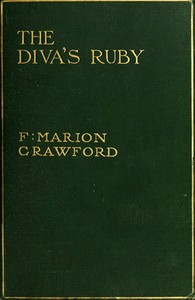
The Diva's Ruby — Story, Setting & Ideas
(0 User reviews)
1691
Project Gutenberg
2012
Not confirmed
Mystery fiction; Rubies -- Fiction; Singers -- Fiction
Readers of public-domain and historical texts
Project Gutenberg digital edition
en
Edition facts
Words
122,500
Reading time
533 min
Text sections
11
This digital edition of The Diva's Ruby — Story, Setting & Ideas is described by source-level measurements including 122,500 words, 8 hr 53 min estimated reading time, and 11 detected text sections.
The text analysis averages about 18.8 words per sentence, while the detected sections provide another way to judge how the source is divided.
Project Gutenberg metadata also associates the work with “Mystery fiction,” connecting these edition facts with the source record’s subject description.
Source:
Project Gutenberg record #40844
Crawford's sequel to Primadonna and Fair Margaret opens with a legendary ruby mine in Central Asia and follows a stolen gem, a diva, and a millionaire's scruples. The excerpts reveal tense letter-passing, a newspaper cutting, and a character's suspicion that the stolen ruby may not be unique.
Editorial Edition Score
4.9/5
★★★★★
★★★★★
Calculated from edition completeness, EPUB availability, text structure and catalogue metadata. Not a user rating.
How this score is calculated
- Description quality20 pts
- Title & short description10 pts
- Source metadata20 pts
- Text length15 pts
- Chapters / structure15 pts
- EPUB file integrity20 pts
Total of 100 points, scaled to a 2.5-5.0 range. Editions with an empty description or a missing EPUB file are not scored.
Edition quality
Read the Text
was much whiter and much more beautiful than the other girls of the little Tartar city; her face was oval like an ostrich egg, her skin was as the cream that rises on sheep's milk at evening, and her eyes were like the Pools of Peace in the Valley of Dark Moons; her waist also was a slender pillar of ivory, and round her ankle she could make her thumb meet her second finger; as for her feet, they were small and quick and silent as young mice. But she was not blessed.
When she was in her seventeenth year a traveller came to the little city, who was not like her own people; he was goodly to see, and her eyes were troubled by the sight of him, as the Pools of Peace are darkened when the clouds lie on the mountain-tops and sleep all day; for the stranger was tall and very fair, and his beard was like spun gold, and he feared neither man nor evil spirit, going about alone by day and night. Furthermore, he was a great physician, and possessed a small book, about the size of a man's hand, in which was contained all the knowledge of the world. By means of this book, and three small buttons that tasted of mingled salt and sugar, he cured Baraka's father of a mighty pain in the midriff which had tormented him a whole week. He brought with him also a written letter from a holy man to the chiefs of the town; therefore they did not kill him, though he had a good Mauser revolver with ammunition, worth much money, and other things useful to believers.
Satan entered the heart of Baraka, and she loved the traveller who dwelt in her father's house, for she was not blessed; and she stood before him in the way when he went out, and when he returned she was sitting at the door watching, and she took care to show her cream-white arm, and her slender ankle, and even her beautiful face when neither her father nor her mother was near. But he saw little and cared less, and was as grave as her father and the other greybeards of the town.
When she perceived that he was not moved by the sight of her, she watched him more closely; for she said in her girl's heart that the eyes that are blind to a beautiful woman see one of three things: gold, or power, or heaven; but her sight was fixed only on him. Then her throat was dry, her heart fluttered in her maiden breast like a frightened bird, and sometimes, when she would have tried to speak, she felt as if her tongue were broken and useless; the fire ran lightly along her delicate body, her eyes saw nothing clearly, and a strange rushing sound filled her ears; and then, all at once, a fine dew wet her forehead and cooled it, and she trembled all over and was as pale as death--like Sappho, when a certain god-like man was near. Yet the stranger saw nothing, and his look was bright and cold as a winter's morning in the mountains.
Almost every day he went out and climbed the foot-hills alone, and when the sun was lowering he came back bringing herbs and flowers, which he dried carefully and spread between leaves of grey paper in a large book; and he wrote spells beside them in an unknown tongue, so that no one dared to touch the book when he went out, lest the genii should wake and come out from between the pages, to blind the curious and strike the gossips dumb, and cast a leprosy on the thief.
At night he lay on the roof of the fore-house beside the gate of the court, because it was cool there. Baraka came to him, before midnight, when her mother was in a deep sleep; she knelt at his side while he slept in the starlight, and she laid her head beside his, on the sack that was his pillow, and for a little while she was happy, being near him, though he did not know she was there. But presently she remembered that her mother might wake and call her, and she spoke very softly, close to his ear, fearing greatly lest he should start from his sleep and cry out.
'The ruby mine is not far off,' she said. 'I know the secret place. Rubies! Rubies! Rubies! You shall have as many as you can carry of the blood-red rubies!'
He opened his eyes, and even in the starlight they were bright and cold. She stroked his hand softly and then pressed it a little.
The story begins not in opera houses or drawing rooms but with a ruby mine hidden in the mountains near a remote Central Asian city, its secret guarded by two families for generations. The only woman to learn the mine's location is Baraka, whose name may mean 'Blessed'—yet the narrator insists 'no blessing came to her when she was born.' This fairy-tale opening, with its precise, almost ethnographic details (her waist 'a slender pillar of ivory,' her feet 'small and quick and silent as young mice'), establishes a world where beauty and secrecy are intertwined. The novel then shifts to a very different setting: a European resort where Margaret, the diva, orchestrates a covert exchange of letters with the millionaire Van Torp, hiding them behind a parasol while Mrs. Rushmore is absorbed in conversation with Kralinsky.
Secrecy and Surveillance
The excerpts are thick with acts of concealment and observation. Margaret crams letters into her glove, coughs as a signal, and drops her parasol to pass documents unseen. Van Torp, reading a newspaper cutting, is himself watched: 'She watched him intently while he read the printed report,' the text notes, adding that through her veil she could see his expression while he could not see hers. This asymmetry of vision—one character scrutinizing another who is unaware—recurs. Earlier, the narrator describes how the traveller's appearance troubled Baraka's eyes 'as the Pools of Peace are darkened when the clouds lie on the mountain-tops.' The language of watching, hiding, and reading faces pervades both the Central Asian legend and the contemporary intrigue.
The Ruby's Ambiguity
The stolen gem is never simply a jewel. Van Torp, after reading the newspaper report, asks whether the ruby Margaret received from Logotheti looks like the one that was stolen. When she says no, he speculates: 'if these people are around selling rubies, there may be two very much alike.' He even wonders whether the girl who was robbed might have had 'another stone about her a good deal like the one that was stolen.' The expert Pinney swore to the ruby's identity, but Van Torp's line of questioning introduces doubt. The stone he himself gave Margaret he admits might be glass. The ruby thus becomes a locus of uncertainty—its authenticity, uniqueness, and ownership all open to question.
Shifting Alliances and New Scruples
Margaret's intimacy with Van Torp grows rapidly, yet the narrator notes that if she had not been angry with Logotheti, she 'would have been amazed at the strides her intimacy with Van Torp was making.' Van Torp, accustomed to fighting for fortune, now feels 'scruples wholly new to him'—things that seemed fair when millions were at stake now appear 'low down' where Margaret is the prize. The millionaire's internal shift, juxtaposed with Margaret's anger and the covert exchange, suggests a realignment of loyalties. The excerpt ends with Van Torp carefully folding the newspaper slip and putting it in his pocket-book rather than returning it to the envelope, a small act that signals his deepening involvement.
Readers approaching The Diva's Ruby should attend to the interplay between the opening legend and the later scenes of modern intrigue. The mine's secret, passed through men but learned by one woman, echoes the later transactions around the ruby—passed from Logotheti to Margaret, then to London, and now subject to Van Torp's scrutiny. The novel rewards attention to who sees whom, who hides what, and how objects like a parasol, a glove, or a newspaper cutting become tools of deception.
I keep thinking about that ruby’s singular weight in Crawford’s tale—how a stone can carry so many private doubts. It reminds me of those unresolved threads in the Professor’s own story, the ones that linger long after the final page. The Professor's Mystery — Inside the Classic feels like a quiet companion to that unease, a familiar ache I didn’t expect to find again.
There are no reviews for this eBook.
There are no comments for this eBook.
Reader reflection
What did you think of this book?
Answer a few questions and save a private reflection on this device.
Your progress
0
/
10
2
Was reading this book enjoyable?
3
Would you pass this book on to a friend?
4
How much effort did this book require?
5
Did the book deliver what you hoped for?
6
Would you read this book again?
7
Would you start a conversation about this book?
8
How distinctive were its ideas or approach?
9
What changed or sharpened your thinking?
10