1

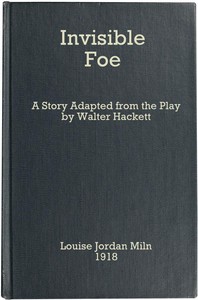
The Invisible Foe A Story Adapted from the Play by Walter Hackett — Themes and Context
(0 User reviews)
61
Project Gutenberg
2015
Not confirmed
England -- Fiction; Paranormal fiction; Mystery fiction; Families -- Fiction; Embezzlement -- Fiction
Readers of public-domain and historical texts
Project Gutenberg digital edition
en
Edition facts
Words
68,685
Reading time
299 min
Text sections
7
The source record for The Invisible Foe A Story Adapted from the Play by Walter Hackett — Themes and Context measures this digital text at 68,685 words, 4 hr 59 min estimated reading time, and 7 detected text sections.
The text analysis averages about 13.3 words per sentence, while the detected sections provide another way to judge how the source is divided.
Project Gutenberg metadata also associates the work with “England -- Fiction,” connecting these edition facts with the source record’s subject description.
Source:
Project Gutenberg record #50188
An editorial note examining the adapted novel's diction and dialogue, focusing on Stephen's obsessive bird-watching, the children's contrasting characterizations, and the use of sensory details to create atmosphere.
Editorial Edition Score
4.7/5
★★★★★
★★★★★
Calculated from edition completeness, EPUB availability, text structure and catalogue metadata. Not a user rating.
How this score is calculated
- Description quality20 pts
- Title & short description10 pts
- Source metadata20 pts
- Text length15 pts
- Chapters / structure15 pts
- EPUB file integrity20 pts
Total of 100 points, scaled to a 2.5-5.0 range. Editions with an empty description or a missing EPUB file are not scored.
Edition quality
Read the Text
n was playing by herself.
Nothing could have been more characteristic of the three children than their occupations of the moment.
Stephen usually was watching birds fly, when he was out of doors, and birds were to be seen. And the only time his uncle Richard had ever laid a hand (except in rare caress or in approbation) on the orphan boy, had been when Stephen, three months after his arrival at Deep Dale, had opened its cage, and lost Helen her pet canary—all because he “wanted to see just how he flies.”
“And I did see, too,” he had told Hugh an hour after his stoically endured caning. “It was worth more than a few smacks. Bet I can fly too, some day. You wait.”
Hugh had said nothing. He was used to Stephen and Stephen’s vivid ambitions. And he was stolid.
Stephen had suffered his slight chastisement proudly—if not quite gladly—but with each faltering fall of his uncle’s cane a seed of bitterness had entered the child’s soul. He never had felt the same to “Uncle Dick” since—which was no small pity, for the orphan boy was love-hungry, and Richard Bransby his best friend.
The small punishment bred deceit but worked no cure. The men in the fowl-yard could have told sad tales of staid hens aggravated to indignant, fluttering flight, and the old gardener of peacocks goaded to rise from their self-glorified strutting and preening to fly stiff and screaming the few spaces which were their farthest. But neither the farm hands nor the gardener told. Why—it is not easy to say. They did not particularly like Stephen—few people did. But they feared him. He mastered their wills. A solitary child, not half so happy as childhood has every right to be, the boy met few he did not influence sharply. His was a masterful nature. Little altogether escaped his subtle dominance.
Stephen was not essentially cruel. His cruelty was corollary and accessory to his passion—a passion for power and for the secrets of aerial skill. He bore the birds no ill-will. He simply was obsessed to see their flight, and to study it, garnering up in his odd, isolated, accretive child’s mind—and heart—every vibrant curve and beat of their wings, every angle and bend of their bodies.
Stephen usually was watching the flight of a bird, or scheming some mechanical imitation of it.
Hugh usually was doing something for wee Helen, doing it with perspiring and sighful awkwardness and for scant thanks—or for none.
Helen usually was playing by herself, and pretending, as now, to be sharing the sport of some playfellow, perfectly tangible to her, but invisible, non-existent to the boys—a form of persistent “make believe” which greatly amused Hugh and as greatly irritated Stephen.
“Don’t pretend like that; it’s a simpleton way of going on,” the older boy called to her now, without moving his head or his eyes.
“It’s nothing of the kind,” the girl replied scornfully. “You’re blind, that’s what’s the matter—blinder’n a bat, both of you.” And she continued to laugh and chat with her “make-believe” playmates.
An elfin child herself, the children of her own delicate myth did seem the more suitable fellows for her dainty frolic than either queer Stephen or stolid, clumsy Hugh.
The opening chapter of The Invisible Foe establishes character through action rather than exposition. Stephen lies on his stomach, watching a bird's flight with "hungrily" following eyes, while Hugh awkwardly makes a chain of blossoms and Helen plays alone. The narrator immediately interprets these occupations as "characteristic," signaling a method of indirect characterization that persists throughout the novel. Stephen's obsession with flight—later revealed as a driving ambition to become an "Air-King"—is introduced through a single, telling anecdote: he freed Helen's canary to see how it flies, accepting a caning as a fair price. The passage notes that this punishment "bred deceit but worked no cure," a compact summary of a moral trajectory.
Diction and the Language of Obsession
The novel's diction repeatedly reinforces Stephen's fixation on flight. Verbs like "followed hungrily" and "goaded to rise" attribute predatory intensity to his watching. The narrator describes his cruelty as "corollary and accessory to his passion," a clinical phrasing that distances moral judgment while underscoring compulsion. In dialogue, Stephen's ambition emerges in clipped, confident statements: "Bet I can fly too, some day. You wait." The adaptation from play to novel preserves such terse lines, suggesting the source material's reliance on spoken revelation. Later, when Stephen recites "Darius Green and His Flying Machine" with theatrical solemnity, the poem's absurdity contrasts with his genuine longing—a tonal dissonance that hints at the character's complexity.
Dialogue as a Window to Character
Dialogue in the excerpts often serves to differentiate the three children. Hugh is nearly silent; his few words are practical or acquiescent. Stephen speaks in declarations and challenges. Helen, when she recites the poem, uses a "beautiful Creole voice, now pathetic and velvet, now lifted as the wing of a bird in flight," a description that merges her speech with Stephen's avian imagery. The adult characters employ more formal registers: Latham's abrupt question "How many rings do you own?" and his soft reply "You need two more" carry romantic subtext through understatement. The adaptation's dialogue retains a theatrical crispness, with lines that could be delivered onstage—short, pointed, and freighted with implication.
Sensory Description and Atmosphere
The novel builds atmosphere through sensory details that evoke cold, darkness, and neglect. In Chapter XXI, the room is described with "gray shadows hung thick in the place, palpable and dreary," and "thin shafts of sickly light" that "intensify" rather than lift the gloom. The jade Joss and rose-colored lotus appear "pinched, gray and frozen," personified as "poor exiled pair." Such tactile and visual language creates a mood of decay and secrecy. The act of entering the locked room is accompanied by a "creaking and stiffly" turning key, and Mrs. Leavitt's shiver and ungingerly steps. These details, drawn from the adapted play's stage directions, ground the supernatural and criminal elements in a tangible, oppressive setting.
Narrative Voice and Moral Commentary
The narrator frequently interjects moral observations that guide reader interpretation. Of Stephen's caning, the text states: "The small punishment bred deceit but worked no cure." Later, it notes that Stephen "never once had repented" and would "hesitate at nothing" to achieve his desires. These judgments are delivered in a detached, almost clinical tone, contrasting with the vivid action scenes. The narrator also comments on the children's psychology: Stephen is "love-hungry" and "a solitary child, not half so happy as childhood has every right to be." Such statements, while not attributing motive, frame the character's actions within a moral landscape. The adaptation's narrative voice thus functions as a subtle guide, shaping sympathy and suspicion without resorting to explicit condemnation.
Readers attentive to the novel's diction will notice how the adapted play's origins shape its prose: dialogue carries the burden of revelation, while descriptive passages amplify mood. The recurring motif of flight—literal in Stephen's bird-watching, metaphorical in his ambitions—threads through scenes of domestic tension and criminal intrigue. The editorial note above highlights only a few of the authorial choices visible in the excerpts; the full text likely extends these patterns into a sustained exploration of obsession and its costs.
Some afternoons I catch myself thinking of The Invisible Foe—how Stephen’s watchfulness isn’t a crime, but a kind of longing. It sits beside that other quiet fellow, Murder by the clock — Story, Setting & Ideas, like two strangers sharing a bench. Both understand that time moves oddly when we’re listening for something unseen.
There are no reviews for this eBook.
There are no comments for this eBook.
Reader reflection
Your personal reading reflection
Build a private reading journal entry for this title.
Your progress
0
/
10
2
How much did you enjoy the reading experience?
3
How likely are you to recommend this book?
4
What was the reading difficulty like?
5
How valuable was this book for your own interests?
6
How clearly were the main ideas presented?
7
Did the book offer a fresh perspective?
8
How strong was your personal connection to the text?
9
In one sentence, what did you learn?
10