1

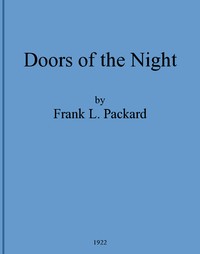
Doors of the Night — Key Ideas to Explore
(0 User reviews)
703
Project Gutenberg
2011
Not confirmed
New York (N.Y.) -- Fiction; Adventure stories; Criminals -- Fiction; Mystery fiction
Readers of public-domain and historical texts
Project Gutenberg digital edition
en
Edition facts
Words
107,898
Reading time
470 min
Text sections
29
Doors of the Night — Key Ideas to Explore can be approached with a clearer sense of reading commitment from its source measurements: 107,898 words, 7 hr 50 min estimated reading time, and 29 detected text sections.
The text analysis averages about 16.4 words per sentence, while the detected sections provide another way to judge how the source is divided.
Project Gutenberg metadata also associates the work with “New York (N.Y.) -- Fiction,” connecting these edition facts with the source record’s subject description.
Source:
Project Gutenberg record #35818
Frank L. Packard's 1922 crime novel follows Billy Kane through New York's underworld, where locked doors, false identities, and shifting luck drive a taut narrative. The prose shifts from measured domestic scenes to frantic, shadowy pursuits, with sensory details and pacing changes marking each turn.
Editorial Edition Score
4.9/5
★★★★★
★★★★★
Calculated from edition completeness, EPUB availability, text structure and catalogue metadata. Not a user rating.
How this score is calculated
- Description quality20 pts
- Title & short description10 pts
- Source metadata20 pts
- Text length15 pts
- Chapters / structure15 pts
- EPUB file integrity20 pts
Total of 100 points, scaled to a 2.5-5.0 range. Editions with an empty description or a missing EPUB file are not scored.
Edition quality
Read the Text
resently to the library—that there was a little matter he wished to attend to. There was nothing strange in that, for they often worked together here in this room in the evenings, and yet Billy Kane’s puzzled frown deepened. There was something certainly amiss with the old multi-millionaire tonight, and that anything should disturb the old philanthropist’s tranquillity, except when his sympathies had been aroused and the man’s heart, that was softer than a woman’s, had been touched by some pathetic appeal, was decidedly strange.
Billy Kane continued his pacing up and down the room in long, athletic strides, the great, broad shoulders squared back as his hands were thrust into the pockets of his jacket. It was far more than a feeling of respect or mere liking that he held for his employer, for there had come esteem for the old gentleman’s sterling qualities, and with the esteem a sincere affection, and out of it all, very curiously, a sort of fathering, or protecting interest for this man of millions.
The frown passed away, and Billy Kane smiled a little whimsically at the somewhat quaint conceit. Fathering! Nevertheless, it was true! There was scarcely an hour of the day that some appeal for charity, ranging from a few cents to many thousands of dollars, was not made upon David Ellsworth—too many of them spurious, and it was his, Billy Kane’s, self-appointed task to stand between his employer and these fraudulent attempts. All the world, at least all the world within reach, seemed to be thoroughly conversant with the old gentleman’s ask-no-questions liberality—and to lose no opportunity in taking advantage of that knowledge! For instance, though here he was forced to the belief that it was genuinely worthy, there was the case of the deformed beggar, one Antonio Laverto, who, during the last week, had taken up his station on the corner a block away from the house. The beggar had already secured the old gentleman’s attention, and also a dollar or two every time David Ellsworth passed; in return for which David Ellsworth had become possessed of a very pitiful life history, and also possessed of a desire to set the man squarely on his feet again.
Billy Kane paused abruptly in his stride, as his eyes rested on the portières that hung before one of the two doorways at the lower end of the room. Behind that door, which was one of wood matching the other doors of the room, was a door of solid steel, and behind the steel door was one of the strongest vaults in the city of New York, and in the vault, besides the magnificent collection of rubies that nestled in their plush-lined trays, a collection that, while but a hobby, had yet made their owner even more famous and widely known than had his millions, were thousands of dollars—_the money kept there for the sole purpose of being given away_! Eccentricity? Well, perhaps—but if so, it was a very fine eccentricity, the eccentricity of one of God’s own noblemen.
One of God’s own noblemen! Yes, he had good reason to call David Ellsworth that! Billy Kane’s strong face softened. As a boy is acquainted with his father’s companions, he had been acquainted with David Ellsworth for many years, it was true; but he had never known the other for his real worth until the last three months, during which time he had been the retired magnate’s confidential secretary. His father had been an old friend of David Ellsworth; and a little more than three months ago his father had died, just as he, Billy Kane, had graduated from Harvard. His father’s estate, supposedly large, had turned out to amount to comparatively nothing; the net residue of the estate, which had just been wound up, being represented by the sum now at his credit in the bank, a matter of something less than five thousand dollars. Apart from that, there was nothing. His mother had been dead many years; and, with no ties to hamper him, he had been casting around for some opening where he could utilize his university degree in arts to the best advantage, when he had received the offer from David Ellsworth to act as the latter’s confidential secretary. He had accepted at once, and since then he had led a rather singular existence.
From its first sentence, Doors of the Night establishes a narrator who lingers on physical details—the “indirect lighting,” “priceless Oriental rug,” and “massive desk of dark, carved wood” of a Fifth Avenue library—before abruptly shifting to a protagonist pacing in “long, athletic strides.” This contrast between static observation and restless movement recurs throughout the excerpts, as Billy Kane moves from the measured world of his employer David Ellsworth into a labyrinth of locked doors, false names, and dark hallways. The prose itself mirrors this transition: early passages use balanced, almost leisurely sentences, while later ones fragment into short, urgent clauses (“The door was unlocked, but it availed him nothing at all now”).
A Voice That Watches and Hurries
The narrative voice in the excerpts oscillates between two registers. In the opening, the third-person narrator adopts a connoisseur’s tone, describing the room with “measured approval such as a connoisseur who knew his art might bestow upon a canvas.” The sentences are long, with multiple clauses linked by commas and semicolons. But once Billy Kane leaves the library, the prose tightens. When he crouches before a door in a dark hallway, the sentences shorten: “He tried another with the same result. He was not an adept at lock-picking as yet! He grinned without mirth.” The exclamation point and the ironic self-correction (“as yet”) inject a nervous energy absent from the earlier pages. This shift in sentence length and punctuation marks a change in the character’s situation—from observer to actor, from safety to risk.
Doors, Keys, and the Rhythm of Luck
The excerpts repeatedly return to doors and keys as both physical objects and symbols of access or denial. Billy Kane unlocks a door, tries skeleton keys, retreats when footsteps approach. The word “door” appears in nearly every paragraph of the later excerpt, often paired with a verb of hesitation or failure: “tried the door cautiously,” “found it locked,” “drew back.” This repetition creates a rhythmic pattern of attempt and setback. The narrator explicitly comments on luck: “It seemed as though every turn of the luck had gone against him.” The pacing accelerates when Kane hears footsteps on the stairs—the prose shifts from description to a staccato sequence of actions (“He thrust the automatic abruptly back into his pocket. … He exchanged the keys for his automatic once more”). The reader is pulled into the same breathless uncertainty as the protagonist.
Shadows, Hallways, and Unreliable Senses
Packard builds suspense through limited visibility and sensory confusion. In the later excerpt, the hallway is described as “murky,” “darkness,” and “shadows.” Billy Kane sees “little more than a shadowy outline” of the violin player Savnak. The narrator reports Kane’s internal state with phrases like “his mind fogged” and “a numbed, dazed way.” When two men appear, Kane initially mistakes them for Peters, then recognizes them as “Red Vallon, and Birdie Rose”—but the narrator does not explain who these men are or why their presence is alarming. The reader shares Kane’s disorientation. The prose mirrors this by withholding information: “Out of the darkness he watched them, his mind fogged.” The effect is a narrative that feels as trapped and uncertain as its protagonist, with every sound and shadow potentially a threat.
Readers attentive to Packard’s craft will notice how the novel’s language does not merely describe action but enacts it. The shift from the measured, almost architectural prose of the opening to the fragmented, breathless sentences of the later chapters is a deliberate tool for building tension. Pay attention to how often the narrator uses words like “shadow,” “dark,” “door,” and “luck”—they form a pattern that reinforces the story’s central anxieties. The excerpts offer only a glimpse of the full plot, but they reveal a writer who controls pace through syntax and sensory detail.
I finished Doors of the Night last week, and Billy Kane’s fake names, his shifting luck, kept me up past midnight. That feeling of never quite knowing which door was safe—it stuck with me, soft and uneasy. I remembered The Indian Drum — Edition Insights for that same quiet pull, a story that lingers like a hallway light left on.
There are no reviews for this eBook.
There are no comments for this eBook.
Reader reflection
How will you remember this book?
Save your reaction, strongest insight, and memorable passage.
Your progress
0
/
10
2
How did the book work for you overall?
3
Would you recommend this book to another reader?
4
Did the language feel accessible?
5
How clear did the writing feel?
6
How would you describe its reading pace?
7
How much did the book move you?
8
How strong was your personal connection to the text?
9
What did this book teach you most?
10