1

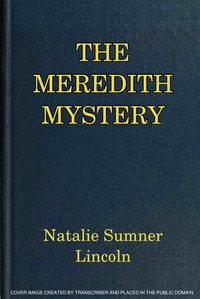
The Meredith Mystery — Reading Companion
(0 User reviews)
1590
Project Gutenberg
2019
Not confirmed
Detective and mystery stories; Inheritance and succession -- Fiction; Murder -- Investigation -- Fiction; Blind -- Fiction
Readers of public-domain and historical texts
Project Gutenberg digital edition
en
Edition facts
Words
58,835
Reading time
256 min
Text sections
19
Before opening The Meredith Mystery — Reading Companion, the edition data offers a quick orientation: 58,835 words, 4 hr 16 min estimated reading time, and 19 detected text sections.
The text analysis averages about 12.9 words per sentence, while the detected sections provide another way to judge how the source is divided.
Project Gutenberg metadata also associates the work with “Detective and mystery stories,” connecting these edition facts with the source record’s subject description.
Source:
Project Gutenberg record #58597
Natalie Sumner Lincoln's 1923 mystery uses a blind detective, David Curtis, whose tactile and olfactory observations drive the investigation. The narrative hinges on a scented handkerchief, a disputed key, and conflicting testimony, with dialogue revealing class tensions and family coercion.
Editorial Edition Score
4.8/5
★★★★★
★★★★★
Calculated from edition completeness, EPUB availability, text structure and catalogue metadata. Not a user rating.
How this score is calculated
- Description quality20 pts
- Title & short description10 pts
- Source metadata20 pts
- Text length15 pts
- Chapters / structure15 pts
- EPUB file integrity20 pts
Total of 100 points, scaled to a 2.5-5.0 range. Editions with an empty description or a missing EPUB file are not scored.
Edition quality
Read the Text
et your decision, Doctor Curtis,” she said, and turned to Hollister. “Will you tell John?”
“If he is awake, yes; if not, the news will keep until to-morrow.” Hollister concealed a yawn. “Good night, Mrs. Meredith,” as she walked toward the entrance. Curtis’ mumbled “good night” was almost lost in her clear echo of their words as she disappeared through the portières.
“Coming upstairs, Curtis?” asked Hollister, pausing on his way out of the library. “Can I help you to your room?”
“Thanks, no. I’ve learned to find my way about fairly well,” answered Curtis. “I’ll stay down and smoke for a bit longer.”
“All right, see you in the morning,” and Hollister departed, after first pausing to pick up several magazines.
In spite of his statement that he was fairly familiar with his surroundings, it took Curtis some moments to locate the smoking stand and a box of matches. While lighting his cigar he was conscious of the sound of voices in the hall, which grew louder in volume and then died away. He had resumed his old seat and his cigar was drawing nicely when a hand was laid on his shoulder.
“Sorry to startle you,” remarked the newcomer. “I am Gerald Armstrong.”
“Yes, I recognize your voice,” Curtis started to rise, but his companion, one of the week-end house guests at Ten Acres, pressed him back in his chair.
“I only stopped for a word.” Armstrong hesitated as if in doubt. “I’ve just learned of—that you and Anne Meredith are to be married.”
“Yes,” answered Curtis as the pause lengthened. “Yes?”
“You are going through with the ceremony?”
Curtis turned his head and looked up with sightless eyes in Armstrong’s face.
“Certainly. May I ask what affair it is of yours?”
“None,” hastily. “But you don’t know Anne—”
“Oh, yes, you know that she is the only daughter of Mrs. Marshall Meredith and the niece and reputed heiress of John Meredith, millionaire banker,” Armstrong’s usually pleasant voice was harsh and discordant. “As to the girl herself—you are marrying Anne, sight unseen.”
With a bound Curtis was on his feet and Armstrong winced under the grip of his fingers about his throat.
“Stand still!” The command was issued between clenched teeth. “I won’t hurt you, you fool!” Shifting his grip Curtis ran his sensitive fingers over Armstrong’s face and brow. He released him with such suddenness that Armstrong, who had stood passive more from surprise than any other motive, staggered back. “Go to bed!”
Armstrong hesitated; then without further word, whirled around and sped from the library.
Curtis did not resume his seat. Instead he paced up and down the library, dexterously avoiding the furniture, for over an hour. At last, utterly exhausted, he dropped into a chair near the doorway. His brain felt on fire as he reviewed the events of the evening. He had promised to marry a girl unknown to him three days before. He would marry her “sight unseen.” God! To be blind! Fate had reserved a sorry jest for him. What could be the motive behind John Meredith’s sudden friendliness for him, his invitation to spend a week at Ten Acres, and now his demand that he and Anne Meredith go through a “marriage of convenience”?
And he had weakly consented to the plan! Curtis rubbed a feverish hand across his aching forehead. Forever cut off from practicing his beloved profession, with poverty staring him in the face, handicapped by blindness, it was a sore temptation to be offered twenty-five thousand dollars a year to go through a mere ceremony. But he had steadfastly refused until Mrs. Meredith had pointed out to him that Anne would thereby lose a fortune.
Anne—his face softened at the thought of her. Could it be that she had sung her way into his heart? The evening of his arrival he had spent listening enthralled to her glorious voice. Her infectious laugh, the few times that she had addressed him, lingered in his memory.
With a sigh he arose, picked up his cane and felt his way out into the hall. He had cultivated a retentive memory and his always acute hearing had aided him in making his way about. He had grown both sure-footed and more sure of himself as his general health improved. At John Meredith’s suggestion he had spent a good part of a day familiarizing himself with the architectural arrangements of the old mansion until he felt that he could find his way about without great difficulty.
From its first chapter, The Meredith Mystery establishes a pattern of coercive dialogue and sensory detail. Anne Meredith's refusal to marry David Curtis is met with her mother's biting irony: “And what are we to live on in the meantime?” The threat of disinheritance is presented not as melodrama but as a financial trap, with Mrs. Meredith revealing her bank account is overdrawn. The word “beggars” is repeated with cruel insistence, grounding the conflict in economic desperation rather than romantic intrigue.
Lincoln's prose favors concrete objects as evidence. A handkerchief, described as “of the finest linen, of dainty size,” carries a faint chloroform odor and a solitary initial “A.” David Curtis, though blind, reads the world through touch and smell, his “long, sensitive fingers” tracing the handkerchief's edges. This sensory method becomes the novel's investigative engine, privileging physical traces over visual testimony.
Diction of Duress and Defiance
The opening dialogue between Anne and her mother is laced with economic vocabulary that frames marriage as a transaction. Mrs. Meredith's phrases—“square accounts,” “brought you up as his heiress,” “savings from your allowance”—reduce Anne's autonomy to a balance sheet. Anne's retort, “I can work,” is immediately undercut by her mother's reply: “And starve—” The dash and the unfinished sentence imply a threat more potent than explicit argument.
Lincoln uses repetition to hammer home the stakes. The word “beggars” appears twice in rapid succession, first as a noun, then as a concept “beat[ing] its meaning into Anne Meredith's brain.” The dialogue avoids period slang, instead relying on clipped, declarative sentences that convey urgency. When Anne laughs “a trifle unsteadily” and calls the situation “too melodramatic for belief,” her self-awareness does not diminish the pressure; it underscores her entrapment.
The Handkerchief as Silent Witness
David Curtis's discovery of the handkerchief in his pajama pocket is a masterclass in tactile deduction. The narrative describes his fingers “travel[ing] around its edges” and “slowly trac[ing] out the solitary initial—the capital letter ‘A.’” The handkerchief is not merely a clue; it is a physical object that carries the story's central ambiguity. Its faint chloroform odor links it to the murder scene, yet its ownership remains uncertain.
Lincoln avoids describing the handkerchief's appearance visually, instead focusing on texture and scent. Curtis judges it “of the finest linen, of dainty size” through touch alone. This sensory limitation mirrors his blindness and forces the reader to rely on the same non-visual cues. The handkerchief becomes a symbol of hidden knowledge—a piece of evidence that can be held, smelled, and traced but not fully interpreted without context.
Voice and the Unreliability of Testimony
Testimony in The Meredith Mystery is consistently filtered through subjective perception. Herman the butler “thought he recognized” Anne's dress; Gretchen the chambermaid “overheard a conversation” but could not identify the speakers. Lincoln uses indirect attribution to highlight the fallibility of witness accounts. When McLane asks Curtis to list “the known facts connecting Anne with the murder,” Curtis's response is a litany of hearsay: “Herman testified… he took her to be Anne… Gretchen said…”
The dialogue between Curtis and McLane reveals how evidence is constructed from inference. McLane's statement that “Anne knows more than she has told” is not a fact but an opinion, yet it carries weight because of his professional authority. Lincoln shows how suspicion spreads through conversation, not through concrete proof. The novel's structure—chapters titled “Testimony,” “Suspicion,” “The Inquest”—underscores the gap between what is said and what is true.
Setting as a Constraint on Action
The Meredith household functions as a closed system where movement is monitored and privacy is illusory. Doors are tapped, conversations are overheard, and rooms are entered without invitation. When McLane knocks at Curtis's door, the narrative notes that Curtis “securedly locked the handkerchief inside” his despatch box before responding. The act of locking is a reflex, a response to the constant threat of intrusion.
Lincoln uses the house's geography to create tension. The bedroom where Meredith is murdered becomes a recurring site of investigation, and the hallway below Gretchen's window is a stage for overheard dialogue. Characters are frequently described as “seating themselves” or “closing the door behind them,” gestures that emphasize the importance of boundaries. The setting is not merely backdrop but an active participant in the plot, limiting what characters can see, hear, and do without detection.
Readers attentive to Lincoln's use of sensory detail will find that objects—a handkerchief, a key, a pair of pajamas—carry more weight than spoken assurances. The novel rewards careful attention to who touches what and when, as physical evidence often contradicts verbal testimony. The blind detective's method offers a model for reading: trust the texture of the text over its surface statements.
There’s a particular hush in The Meredith Mystery — Reading Companion, the way David Curtis reads a room through scent and touch. It always reminds me of a quieter clock winding down in The Clock and the Key — A Reader’s Guide — both trust what the hands never say aloud. Old friends, those two.
There are no reviews for this eBook.
There are no comments for this eBook.
Reader reflection
How did this book work for you?
Your answers remain private and are stored only in this browser.
Your progress
0
/
10
2
Did this book hold your interest?
3
Would you recommend this book to another reader?
4
How easy was the book to follow?
5
Did the book meet your expectations?
6
How would you describe its reading pace?
7
What was its emotional impact?
8
Would you read this book again?
9
What did this book teach you most?
10