1

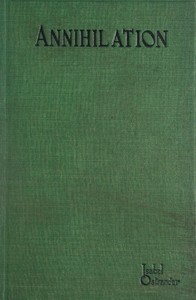
Annihilation — Edition Insights
(0 User reviews)
341
Project Gutenberg
2024
Not confirmed
New York (N.Y.) -- Fiction; Detective and mystery stories; Murder -- Investigation -- Fiction
Readers of public-domain and historical texts
Project Gutenberg digital edition
en
Edition facts
Words
93,305
Reading time
406 min
Text sections
26
This digital edition of Annihilation — Edition Insights is described by source-level measurements including 93,305 words, 6 hr 46 min estimated reading time, and 26 detected text sections.
The text analysis averages about 16.3 words per sentence, while the detected sections provide another way to judge how the source is divided.
Project Gutenberg metadata also associates the work with “New York (N.Y.) -- Fiction,” connecting these edition facts with the source record’s subject description.
Source:
Project Gutenberg record #72948
Isabel Ostrander's 1924 mystery follows ex-roundsman Timothy McCarty as he investigates a series of deaths linked to a mysterious organ in a New York house. The narrative shifts from gritty street scenes to tense indoor confrontations, with a focus on McCarty's seasoned perspective and the ominous 'breath of death' motif.
Editorial Edition Score
4.9/5
★★★★★
★★★★★
Calculated from edition completeness, EPUB availability, text structure and catalogue metadata. Not a user rating.
How this score is calculated
- Description quality20 pts
- Title & short description10 pts
- Source metadata20 pts
- Text length15 pts
- Chapters / structure15 pts
- EPUB file integrity20 pts
Total of 100 points, scaled to a 2.5-5.0 range. Editions with an empty description or a missing EPUB file are not scored.
Edition quality
Read the Text
if an exhausted man in mortal terror or agony drops dead in his tracks and they ship him to the morgue as an acute alcoholic it’s nothing to me!”
Dennis emptied the contents of his pipe into the tray and rose.
“Where do we start from?” he asked excitedly. “Thanks be, I’ve the next twenty-four hours off duty! Do we have a talk with his folks first or what?”
“First and last, we mind our own business this time!” McCarty waved toward the chair. “Sit down again and light up, Denny, and I’ll give you the dope on it, though there’s little enough according to Terry Keenan and Mike Taggart—”
“Terry Keenan and Mike—!” Dennis obeyed tensely. “That’ll be down in the old precinct, then, along the waterfront! Who was the guy and what was he running from when he dropped?”
McCarty gave an account of the evening’s occurrence, concisely yet omitting no significant detail. When he had finished, his visitor sat silent for a moment, turning the story over in his none too quick mind. Then he remarked:
“I don’t get it at all, Mac. A prosperous, middle-aged, respectable looking fellow by what you say, with never a scrap of paper on him to show who he was, only that bit of a metal tag! He must have been running from somebody! Did you look behind you?”
“I did not, and neither did he.” McCarty paused. “Mind you that, Denny! I didn’t say he was trying to get away from anybody. The way he was running and stopping and then reeling along once more showed that if he was not half-crazed with pain, ’twas only will power kept him going as far as he got. When Terry and I turned him over, the gray look of his face came from more than his slowing heart. It was horror that stared out of his eyes! He was conscious, too, though the end came in less than a minute, and muttering with his last breath.”
“Do you think he might have been going some place down among the wharves at that hour, and running till his heart burst to get there on time?” Dennis’ pipe had gone out in his excitement and he laid it on the tray with a tremulous hand. “Was it blackmail? Did he think whoever was waiting would kill him if he didn’t show up? Mac, what manner of man was he? Fine quality clothes and cheap shoes, elegant jewelry and a gold-filled watch that could be bought on the installment plan! The cigar case was real pigskin, you tell me, but—what kind of cigars was in it?”
“Denny, you’ve rung the bell again, even though you don’t know it!” McCarty gazed for a moment in affectionate but unflattering surprise at his old friend. “The cigars were Coronas, and there’s no better nor more costly made! For all the clothes were of grand quality, they didn’t fit him; they’d been carefully altered but they’d been made in the beginning for a taller and thinner man—and they’d had good wear. Only the cheap shoes were new, and though the links and pin were as rich-looking as any swell would sport they were fakes, even if I wouldn’t give Taggart the satisfaction of telling him so! He’d too close a shave, remember, and his hands showed no signs of hard work; don’t you make anything at all out of it?”
“He could wear the clothes, though not the shoes, of another man—smoke his cigars, copy his jewelry, keep his own hands soft—? No, there’s no sense to it, whatever!” Dennis shook his head slowly. “You’ve something up your sleeve, but what makes you figure so much on the close shave of him? Why was that number ‘four’ on the other side of the tag with his initials on the key-ring? Did you look to see if the same letters was in his hat?”
“It had dropped down into the gutter when he fell.” McCarty had refrained for the time being from mentioning his errand after the missing headgear. “Did I say that ‘N. Q. M.’ were the dead man’s initials? I fitted a made-up name to them in joke when Taggart was so sure about it, but it might be an address as well. You’ve known this town as long and as well as me, Denny; did you ever hear of the New Queen’s Mall?”
The opening chapter of Annihilation drops the reader into a teeming September downpour, following ex-roundsman Timothy McCarty as he trudges through a mean district of broken sidewalks and squalid tenements. Ostrander establishes a gritty, tactile world from the first sentence: a seven-fifty derby, new that afternoon and already destined to be reblocked. McCarty's voice—colloquial, wry, and seasoned—emerges immediately, as he mutters about the psycho-junk he's been reading and thinks of a place the devil could take this rain. The prose is dense with sensory detail: muddy streams spurt to his knees, a sodden wisp of tobacco hangs from his mustache, and street lamps emit a blurred glimmer that emphasizes the murky gloom. This is a world of physical texture and sharp observation, where a former policeman's trained eye catches a peculiar gait in a stranger and sets the plot in motion.
Voice and Vernacular: McCarty's Ground-Level Perspective
The narrative is anchored by McCarty's voice, which blends Irish-American slang with the weary authority of a retired cop. His internal commentary—like his opinion on the rain or his recollection of old cases—gives the story a conversational, almost confidential tone. Ostrander uses dialect sparingly but effectively: phrases like “True for you, Terry!” and “Glory be, it’s Mac!” mark the characters as rooted in a specific social milieu. McCarty’s observations are concrete and practical; he notices a man’s lurching gait, a bluecoated figure stepping from a doorway, and the way a Chinese butler “chatters like a monkey.” This voice never becomes omniscient or literary; it stays close to McCarty’s limited but sharp perspective, making the reader share his suspicions and gradual understanding.
Pace and Suspense: From Rain-Soaked Streets to Closed Rooms
The novel’s pace shifts markedly between its outdoor and indoor scenes. The opening chapter moves with a trudging, deliberate rhythm, matching McCarty’s walk through the storm. Details accumulate slowly: the description of the neighborhood, the glimpse of the dark figure, the encounter with Terry. Once inside Orbit’s house, the pace tightens. In Chapter XIII, the action becomes rapid and fragmented: McCarty dashes up steps, Dennis crosses himself, Ching Lee drags Fu Moy away. Dialogue is clipped and urgent—Orbit’s voice is “hoarse and shaken,” McCarty’s questions come in a rush. Ostrander builds suspense through physical detail: the humid breath of the conservatory, the organ pipes gleaming like silver birches, the limp form on the marble bench. The horror is not explained but shown through the characters’ reactions—Dennis repeating “The breath of death!”—leaving the reader to piece together the threat.
Recurring Motifs: The Organ, the Breath, and the Closed House
Two motifs recur in the excerpts: the organ and the phrase “breath of death.” The organ is described with a strange, almost animate quality—its slender pipes gleam softly, and its music seems to have a fatal effect. Orbit plays it, and Lucette is found dead on the bench afterward. The Chinese butler Ching Lee warns that Lucette “has breathed the breath of death,” a phrase that Dennis repeats with awe. The house itself becomes a closed, oppressive space: the conservatory door stands wide, but the atmosphere is stifling, heavy with fragrance and dread. Ostrander uses these elements to create a sense of inescapable menace, where music and air itself become vehicles of annihilation. The setting—a wealthy home with a mysterious organist—contrasts sharply with the rain-soaked streets, emphasizing the transition from public to private, from known danger to unknown horror.
Readers will find that Ostrander’s strength lies in her ability to shift between the mundane and the macabre, always anchored by McCarty’s grounded voice. Pay attention to how she uses physical details—a hat, a gait, a breath—to build atmosphere and foreshadow events. The novel rewards close reading of its dialogue and descriptions, where clues are embedded in the characters’ reactions and the environment itself.
That old New York house in Isabel Ostrander’s mystery stays with you, that quiet dread of the organ’s breath. It’s the way certain rooms hold a past you can almost feel. The Professor's Mystery — Inside the Classic has that same lingering weight, a story that settles in the mind gently, like an unsettled memory you keep turning over.
There are no reviews for this eBook.
There are no comments for this eBook.
Reader reflection
What did you think of this book?
Answer a few questions and save a private reflection on this device.
Your progress
0
/
10
2
Was reading this book enjoyable?
3
Would you pass this book on to a friend?
4
How demanding did the text feel?
5
Would this book work well in a reading group?
6
What was the strongest part of the book?
7
How strongly did the book affect you emotionally?
8
How would you describe its reading pace?
9
What did this book teach you most?
10