1

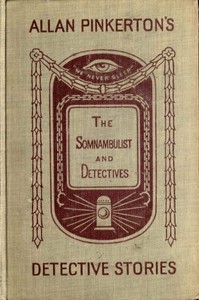
The Somnambulist and the Detective; The Murderer and the Fortune Teller — Themes and Context
(0 User reviews)
2490
Project Gutenberg
2009
Not confirmed
Detective and mystery stories; Detectives -- United States; Murder -- United States
Readers of public-domain and historical texts
Project Gutenberg digital edition
en
Edition facts
Words
66,667
Reading time
290 min
Text sections
6
The source record for The Somnambulist and the Detective; The Murderer and the Fortune Teller — Themes and Context measures this digital text at 66,667 words, 4 hr 50 min estimated reading time, and 6 detected text sections.
The text analysis averages about 18.6 words per sentence, while the detected sections provide another way to judge how the source is divided.
Project Gutenberg metadata also associates the work with “Detective and mystery stories,” connecting these edition facts with the source record’s subject description.
Source:
Project Gutenberg record #30636
Allan Pinkerton's true-crime collection pairs two cases: a somnambulist's involvement in a murder and a fortune teller's role in a crime. The preface insists on factual accuracy, naming living witnesses and court records. Excerpts reveal a detective's methodical observation and a family's emotional turmoil over a seduction.
Editorial Edition Score
4.7/5
★★★★★
★★★★★
Calculated from edition completeness, EPUB availability, text structure and catalogue metadata. Not a user rating.
How this score is calculated
- Description quality20 pts
- Title & short description10 pts
- Source metadata20 pts
- Text length15 pts
- Chapters / structure15 pts
- EPUB file integrity20 pts
Total of 100 points, scaled to a 2.5-5.0 range. Editions with an empty description or a missing EPUB file are not scored.
Edition quality
Read the Text
Atkinson was then a town of medium size, pleasantly situated near the northern boundary of the State. The surrounding country was well watered and wooded, consisting of alternate arable land and rolling hills. The inhabitants of the town were divided into two general classes: the shop-keepers, mechanics, and laborers, formed the bulk of the population; while the capitalists, planters and professional men were the most influential. Most of these latter owned country residences, or plantations outside of the town, though they kept up their town establishments also. A small water-course, called Rocky Creek, skirted one side of the place, and many of the most handsome houses, were situated on, or near this beautiful rivulet. The whole appearance of Atkinson, and the surrounding country, indicated a thrifty, well-to-do population.
Having roamed about to my satisfaction, I spent the latter part of the afternoon at the hotel, where I met a number of the professional men of the county. I found that the hotel was occupied by many of the best families during the winter and spring, and I soon formed the acquaintance of several of the gentlemen. They greeted me with characteristic Southern hospitality, and I was pleased to see that my _role_ as a Scotch speculator was quite an easy one to play; at least, no one ever appeared to suspect my real object in visiting Atkinson.
At the appointed hour I went to the bank, and was met outside by Mr. McGregor, to whom I had been introduced during the day. He took me in through the private entrance, and we were joined in a few minutes by Alexander Bannatine, president, and Peter A. Gordon, vice-president, of the bank. Mr. Bannatine was about fifty years of age, but he looked much older, owing to his continuous and exhausting labors as a lawyer, during the early part of his life. Having made a large fortune by successful practice and judicious investments, he had retired from the active pursuit of his profession, and had joined several old friends in the banking business. Mr. Gordon was, also, about fifty years old. He had become wealthy by inheritance, and had increased his fortune by twenty years of careful attention to business. He was unmarried, and George Gordon, the murdered bank-teller, had stood in the relation of a son to his uncle; hence, there was an additional reason for the capture and conviction of the murderers. The recovery of the large sum of money stolen, would, alone, have been an important consideration, but Mr. Gordon was willing to spend a very extravagant amount in the detection of the criminals, even though the money might never be discovered.
We seated ourselves at a table in the cashier's room, and I prepared to take notes of all the facts then known by the gentlemen present.
"Now, Mr. Bannatine," I said, "please tell me everything connected with the case, which may be of service to me."
"Well, Mr. Pinkerton, I have not been connected with the bank so long, or so closely as Mr. McGregor," said Mr. Bannatine, "and perhaps he had better give a short sketch of young Gordon's connection with the bank first."
"George Gordon was taken into our employ about five years ago," said Mr. McGregor. "He had previously acted as our agent in one of the interior towns, and when he became of age he was offered the place of paying-teller. Since then his obliging disposition, courteous manners, and faithful performance of duty, have endeared him to all his associates, and have given him the confidence of all persons with whom he came in contact. His character was spotless, and his devotion to duty was superior to all allurements; he would never sacrifice one moment to pleasure which should have been given to business."
"Had he any associates among the fast men and women of the place?" I asked.
"No, sir, not one," was the prompt reply; "we have not been able to learn that he had any acquaintances even, among that class."
"Well, please proceed to state all the circumstances connected with the murder," I suggested.
Allan Pinkerton opens his third volume of detective stories with a bold claim: every incident is literally true. He names Maroney, the expressman, living in Georgia, and directs skeptics to court records in Montgomery, Alabama. This insistence on verifiable fact sets the tone for two narratives that blend criminal investigation with domestic drama. The first, The Somnambulist and the Detective, hinges on a sleepwalking witness; the second, The Murderer and the Fortune Teller, involves a fortune teller's prophecy. Pinkerton's method, as described in a contemporary blurb, relies on intuitive reconstruction: with half-closed eyes he sees the crime scene and reads the criminals' movements.
A Detective's Intuition and the Somnambulist's Testimony
The promotional material preceding the text credits Pinkerton with near-instantaneous solutions: “A mysterious problem of crime … presented to his thought, was solved almost in an instant, and seemingly by his intuitions.” This claim is dramatized in the opening excerpt, where the detective flings open a shutter and hears a clerk’s cry of horror. The somnambulist—a sleepwalker—appears as a key witness, though the excerpt does not reveal how her testimony fits the case. Pinkerton’s narrative voice is direct and procedural, focusing on actions and reactions rather than psychological depth. Readers should note how the detective’s observational details—the shutter, the cry—build a scene that feels both immediate and staged.
Family Secrets and Moral Dilemmas in the Second Tale
The second story, The Murderer and the Fortune Teller, shifts to a first-person account from a brother protecting his sister, Annie, from a seducer named Pattmore. The brother’s narration is laden with emotional conflict: “I could hardly keep my hands off his throat when I recollected his villainy; but I curbed my temper by a great effort.” He describes arranging an abortion with a physician named Enfield, then discovering Pattmore’s continued visits. The brother’s weakness—“I have never been able to refuse Annie anything”—contrasts with Pinkerton’s professional detachment. This section introduces themes of shame, manipulation, and the limits of family loyalty, all rendered in plain, confessional prose.
The Fortune Teller's Role and the Murder Plot
Although the excerpts do not fully reveal the fortune teller’s involvement, the title promises her as a catalyst. The brother’s narrative mentions Annie’s interest in wills and her hope that Pattmore’s wife might die, hinting at a murder motive. Pinkerton’s preface assures readers that the story is “literally true,” with living witnesses. The fortune teller likely provides a prediction that drives the plot, but the excerpts leave her specific function ambiguous. Readers should watch for how Pinkerton weaves superstition into his factual framework, and whether the fortune teller’s knowledge is presented as genuine insight or criminal manipulation.
Pinkerton's Narrative Craft: Fact, Emotion, and Suspense
Pinkerton alternates between two distinct voices: the cool, analytical detective in the first story and the anguished brother in the second. This contrast highlights his range as a writer of true crime. The brother’s account is rich with period detail—boarding houses, physicians, political ambitions—that grounds the melodrama in everyday life. Pinkerton’s method, as described in the blurb, involves “judgment as to facts, knowledge of men, the ability to concentrate his faculties on one subject.” Readers can observe this method in action as the detective pieces together clues from behavior and setting. The excerpts suggest that Pinkerton values emotional truth as much as factual accuracy, making his stories both investigative reports and human dramas.
These two stories reward readers who attend to Pinkerton’s dual role as detective and narrator. His insistence on truth does not preclude suspense; rather, it heightens the stakes by reminding us that real people suffered these events. The somnambulist and the fortune teller are not mere plot devices but figures in a moral landscape where sleepwalking and prophecy blur the line between innocence and guilt. Approach the text as a period artifact of crime writing, where fact and feeling are equally weighty.
There’s something touching about how Pinkerton lingers on the quiet details—the hypnotic watchfulness, the family’s grief over a ruined reputation. It reminds me of The Film of Fear — Background and Themes, another old story where dread hides in ordinary rooms. Both feel like half-remembered evenings, the gaslight low, the truth never quite tidy.
There are no reviews for this eBook.
There are no comments for this eBook.
Reader reflection
What was your reading experience?
Capture what you thought, learned, and would like to remember.
Your progress
0
/
10
2
How did the book work for you overall?
3
How likely are you to recommend this book?
4
How easy was the book to follow?
5
Would a second reading be valuable?
6
Did the book give you something worth debating?
7
Which part made the strongest impression?
8
Did any part of the book feel personally relevant?
9
What changed or sharpened your thinking?
10