1

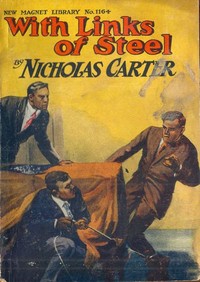
With Links of Steel; Or, The Peril of the Unknown — Themes and Context
(0 User reviews)
1322
Project Gutenberg
2004
Not confirmed
Detective and mystery stories; Dime novels; Popular literature
Readers of public-domain and historical texts
Project Gutenberg digital edition
en
Edition facts
Words
52,396
Reading time
228 min
Text sections
6
With Links of Steel; Or, The Peril of the Unknown — Themes and Context can be approached with a clearer sense of reading commitment from its source measurements: 52,396 words, 3 hr 48 min estimated reading time, and 6 detected text sections.
The text analysis averages about 13.7 words per sentence, while the detected sections provide another way to judge how the source is divided.
Project Gutenberg metadata also associates the work with “Detective and mystery stories,” connecting these edition facts with the source record’s subject description.
Source:
Project Gutenberg record #14096
An editorial note on the dime novel's use of trapdoors, compressed-air elevators, and hidden passages as structural devices, with observations on the interplay between Nick Carter's overconfidence and Cervera's theatrical escapes.
Editorial Edition Score
4.7/5
★★★★★
★★★★★
Calculated from edition completeness, EPUB availability, text structure and catalogue metadata. Not a user rating.
How this score is calculated
- Description quality20 pts
- Title & short description10 pts
- Source metadata20 pts
- Text length15 pts
- Chapters / structure15 pts
- EPUB file integrity20 pts
Total of 100 points, scaled to a 2.5-5.0 range. Editions with an empty description or a missing EPUB file are not scored.
Edition quality
Read the Text
"Mr. Venner--yes, certainly. You will find him in his private office--that way, sir. The door to the right. Venner is in his private office, Joseph, is he not?"
"I don't think so, Mr. Garside, unless he has just returned. I saw him go out some time ago."
"Is that so? Wait a moment, young man."
The young man halted, and then turned back to face Mr. Garside, with an inquiring look in his frank, brown eyes.
"Not here, sir, do I understand?" he asked, politely.
Mr. Garside shook his head. He was a tall, slender man of forty, and was the junior partner of the firm of Rufus Venner & Co., a large retail jewelry house in New York City, with a handsome store on Fifth Avenue, not far from Madison Square.
It was in their store that this introductory scene occurred, and proved to be the initiatory step of one of the shrewdest and most cleverly executed robberies on record.
It was about eleven o'clock one April morning. The sun was shining brightly outside, and at the curbing in front of the store were several handsome private carriages, with stiff-backed, motionless coachmen, in bottle-green livery, perched on their boxes, all of which plainly indicated the very desirable patronage accorded the firm mentioned.
In the store the glare of sun was subdued by partly drawn yellow curtains, which lent a soft, amber light to the deep interior, and enhanced the dazzling beauty of the merchandise there displayed.
The store was a rather narrow one, but quite deep, with a long-counter on each side, back of which were numerous clerks, some engaged in waiting upon the several customers then present.
At the rear of the store was an office inclosure, with a partition of plate glass; while at either side of this inclosure was a smaller room, entirely secluded, these being the private offices of the two members of the firm.
Mr. Garside was standing about in the middle of the store when the young man entered and inquired for Mr. Venner. As he turned from the clerk who had informed him of Venner's absence, he added, half in apology, to his visitor:
"I was mistaken, young man. My clerk tells me that Mr. Venner is out just now. Do you know where he has gone, Joseph?"
"I think he will presently return," said Garside, again reverting to the caller. "Is there anything that I can do for you? Or will you wait until Mr. Venner comes in?"
"I will not wait, Mr. Garside, since you are one of the firm, and probably know about this matter," replied the young man, drawing a small cloth-covered package from his breast pocket. "Here are the ten diamonds for which Mr. Venner sent us an order this morning. I come from Thomas Hafferman, sir, and will leave the stones with you."
The man mentioned was also a jeweler, and a large importer of diamonds and costly gems.
Mr. Garside's countenance took on an expression of mild surprise.
"From Hafferman? An order from Venner?" he murmured, inquiringly. "I was not aware that Venner sent out any order for diamonds this morning."
"One of your clerks brought the order, sir, and requested Mr. Hafferman to send the stones here as soon as convenient," replied the messenger. "Mr. Hafferman did not know your clerk personally, so I was sent here to deliver the stones."
"What is your name, young man?"
"Harry Boyden, sir. I have worked for Mr. Hafferman for nearly five years. I think you will find that the order was properly sent."
"Wait just a moment, Mr. Boyden," suggested Garside, smiling.
Then he hastened to the rear of the store, and spoke through the open window near the cashier's desk.
"Do any of you know of an order sent out by Mr. Venner this morning?" he inquired, addressing the several clerks at work in the office. "An order to Thomas Hafferman for ten diamonds."
Only a girl stenographer, seated at a typewriter near the office door, replied:
"I think Mr. Venner sent Spaulding out about half an hour ago, sir," she replied. "I saw him give Spaulding several letters."
"Ah, doubtless it's all right enough," bowed Garside; "yet I wonder that I had heard nothing about it. Joseph, has Spaulding been here within a few minutes?"
"No, sir," replied the clerk, the same who had at first been questioned. "I saw him go out just before Mr. Venner departed, and he has not yet returned."
Garside had now reached the middle of the store again, where Boyden was still waiting.
"Are you quite sure that the order came from Mr. Venner?" he again inquired. "How long ago was the messenger at your store?"
The opening scene of With Links of Steel establishes a pattern of spatial deception that recurs throughout the narrative. The jewelry store on Fifth Avenue is described with precise detail—the partly drawn yellow curtains, the plate-glass office partition—before the robbery itself unfolds. This careful attention to physical layout becomes a hallmark: rooms, closets, and elevator shafts are never merely settings but active components of the plot. The story repeatedly moves characters through hidden doors, false floors, and compressed-air mechanisms, turning architecture into a weapon.
Trapdoors and Hidden Passages as Plot Engines
The narrative relies on a series of concealed spaces that alter the course of events. In Chapter XIII, Señora Cervera escapes Nick Carter by pressing a peg that opens the back of a closet, revealing a lighted passage. The floor then drops away, functioning as an elevator that descends into the cellar. This is not a one-time trick: the text notes that the Kilgore gang devised the mechanism while masquerading at Cervera's house. The trapdoor reappears in Chapter XIV, where Nick finds himself trapped in the elevator well, the compressed air cushioning his fall. Such devices are not merely decorative; they drive the chase and shift the balance of power between detective and suspect.
The Rhythm of Pursuit and Escape
The story's structure alternates between Nick's methodical investigation and sudden, violent interruptions. Chapter VI, titled "A Shot in the Dark," and Chapter VIII, "Found Dead," suggest a pattern of action followed by discovery. The chapter titles themselves—"A Strategic Move," "Closing In," "In a Warm Corner"—emphasize tactical positioning. The excerpts show Nick moving from the jewelry store to Cervera's residence, each location introducing new obstacles. The detective's overconfidence in Chapter XIII, when he follows Cervera into the closet without anticipating the trap, mirrors a recurring theme: the physical environment often outwits the rational detective.
Recurring Imagery of Light and Darkness
The text contrasts bright, controlled spaces with sudden darkness. The store's "amber light" and "soft, subdued" glare give way to the "darkness enveloping Nick" in the elevator well. Cervera peers down from a "lighted passage" while Nick remains in shadow. This visual polarity reinforces the cat-and-mouse dynamic. The detective's attempts to "feel quietly over the walls" in the dark echo earlier scenes where he relies on sight—the frank brown eyes, the inquiring look. The shift from visual to tactile investigation marks a loss of control, as Nick must adapt to environments designed to disorient.
Movement Between Public and Private Spaces
The narrative moves from the public jewelry store to the private residence of Señora Cervera, each space governed by different rules. In the store, clerks and customers are present; the robbery occurs under the guise of normal commerce. In Cervera's house, the hidden mechanisms suggest a domestic space repurposed for crime. The passage from the closet to the elevator well blurs the boundary between room and machine. This movement is not merely geographic but thematic: the detective's authority diminishes as he enters spaces designed by his adversary. The story's reliance on such transitions gives it a kinetic quality, each scene propelling the reader into a new, often treacherous, setting.
Readers attentive to the physical details—the lever, the peg, the compressed air—will find that the story rewards close observation of how spaces are used. The dime novel format, with its rapid chapter breaks and cliffhanger endings, amplifies the effect of these structural surprises. Rather than a straightforward puzzle, With Links of Steel offers a series of architectural traps that challenge the detective as much as the criminals do.
That rainy afternoon, I kept thinking about Nick Carter’s overconfidence versus Cervera’s theatrical traps—how every hidden door felt like a promise the author had to keep. Then, almost accidentally, I picked up another story where the landscape itself seemed to hide something, not behind compressed air but under a mine’s silence. The La Chance Mine Mystery — Key Ideas to Explore felt like that same unease, only slower, more patient.
There are no reviews for this eBook.
There are no comments for this eBook.
Reader reflection
What did you think of this book?
Answer a few questions and save a private reflection on this device.
Your progress
0
/
10
2
Did this book hold your interest?
3
Would you recommend this book to another reader?
4
How demanding did the text feel?
5
Could you apply anything you learned?
6
How did the reading compare with what you expected?
7
Did you relate to its people, ideas, or situations?
8
Did the book offer a fresh perspective?
9
Which lesson or insight stayed with you?
10