1

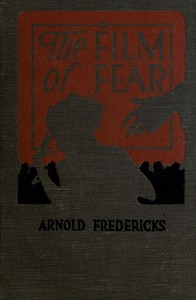
The Film of Fear — Background and Themes
(0 User reviews)
868
Project Gutenberg
2009
Not confirmed
Detective and mystery stories
Readers of public-domain and historical texts
Project Gutenberg digital edition
en
Edition facts
Words
64,704
Reading time
282 min
Text sections
8
Before opening The Film of Fear — Background and Themes, the edition data offers a quick orientation: 64,704 words, 4 hr 42 min estimated reading time, and 8 detected text sections.
The text analysis averages about 13.3 words per sentence, while the detected sections provide another way to judge how the source is divided.
Project Gutenberg metadata also associates the work with “Detective and mystery stories,” connecting these edition facts with the source record’s subject description.
Source:
Project Gutenberg record #29498
A 1917 mystery novel by Arnold Fredericks (pseudonym of Frederic Arnold Kummer) following detective Duvall as he investigates threats against motion picture star Ruth Morton. The narrative contrasts Hollywood glamour with gritty New York clues, including a torn address card and a missing film cutter.
Editorial Edition Score
4.7/5
★★★★★
★★★★★
Calculated from edition completeness, EPUB availability, text structure and catalogue metadata. Not a user rating.
How this score is calculated
- Description quality20 pts
- Title & short description10 pts
- Source metadata20 pts
- Text length15 pts
- Chapters / structure15 pts
- EPUB file integrity20 pts
Total of 100 points, scaled to a 2.5-5.0 range. Editions with an empty description or a missing EPUB file are not scored.
Edition quality
Read the Text
She was a singularly attractive girl, combining a wholesome and quite unassumed innocence with a certain measure of sophistication, gained by daily contact with the free and easy life of the studios. Her brown eyes were large and wondering, as though she still found it difficult to realize that within four years she had stepped from comparative poverty to the possession of an income which a duke or a prince might readily have envied. Her features, pleasing, regular, somewhat large, gave to her that particular type of beauty which lends itself best to the eccentricities of the camera. Her figure, graceful, well modeled, with the soft roundness of youth, enabled her to wear with becoming grace almost any costume, from the simple frock of the school girl to the costly gowns of the woman of fashion. Add to this a keen intelligence and a delightful vivacity of manner, and the reason for Ruth Morton's popularity among motion picture "fans" from coast to coast was at once apparent.
She sat in the handsomely appointed dining-room of the apartment on Fifty-seventh Street which she and her mother had occupied for the past two years. The room, paneled in dull ivory, provided a perfect setting for the girl's unusual beauty. In her kimono of Nile green and gold, she presented a figure of such compelling charm that Nora, her maid, as she removed the empty coffee-cup, sighed to herself, if not with envy, at least with regret, that the good God had not made _her_ along lines that would insure an income of over fifty thousand dollars a year.
Ruth sliced open half a dozen more letters with her ivory paper knife and prepared to drop them into the waste basket. One was from a manufacturer of cold cream, soliciting a testimonial. Two others were from ungrammatical school girls, asking her how they should proceed, in order to become motion picture stars. Another was an advertisement of a new automobile. The fifth requested an autographed picture of herself. She swept the five over the edge of the table with a sigh of relief. How stupid of all these people, she thought, to take up their time, and her own, so uselessly.
The sixth letter, from its external appearance, might readily have been of no greater interest than the other five, and yet, something intangible about it caused her to pause for a moment before inserting the point of the knife beneath the flap of the envelope. It was a large envelope, square, formal-looking. The address upon it was typewritten. Unlike the majority of the other letters, forwarded from the studio, it bore the street and number of the apartment house in which she lived. The envelope was postmarked New York, and was sealed with a splotch of black sealing wax, which, however, contained the imprint of no monogram or seal, but was crossed both vertically and horizontally by a series of fine parallel lines, dividing its surface into minute squares.
Ruth observed these several peculiarities of the letter she was about to open, with growing interest. The usual run of her correspondence was so dull and uninteresting that anything out of the ordinary was apt to attract her attention. Slipping the ivory blade of the paper knife quickly beneath the flap of the envelope, she cut it open.
The letter within, written on the same heavy paper as that composing the envelope, contained but three typewritten lines. It was not these, however, that instantly attracted Ruth's attention, but the signature appended to them. This signature did not consist of a name, but of an astonishing seal, imprinted upon a bit of the same black sealing wax with which the envelope had been fastened. And the device, as Ruth bent over it to make out its clearcut but rather fine lines, filled her with a sudden and overwhelming dismay.
It was a grinning death's head, about half an inch in width, with eye-sockets staring vacantly, and grisly mouth gaping in a wide and horrible smile, made the more horrible by the two rows of protruding teeth. The girl almost dropped the letter, as full realization of the significance of the design swept over her.
Hastily she recovered herself, and with trembling fingers raised the letter from her lap. The three typewritten lines upon the sheet were, if anything, more horrifying than the device beneath them. "Your beauty has made you rich and famous," the letter read. "Without it you could do nothing. Within thirty days it shall be destroyed, and you will be hideous."
The opening pages of The Film of Fear establish a precise, almost clinical tone as Ruth Morton, a motion picture star earning $1,000 per week, sorts her fan mail. The narrator calculates her income to the cent per minute, a detail that underscores the commodification of celebrity. This mechanical accounting contrasts sharply with the vague menace that soon intrudes: a torn card bearing a partial address, a fainting woman in a theater, and a detective named Duvall who must parse slender clues.
The excerpts reveal a story built on dualities—public adulation versus private threat, the polished studio world versus the brownstone boarding houses of Brooklyn and Ninth Street. Duvall’s investigation moves through these spaces with methodical patience, but the text leaves many questions unanswered: who is the woman who fainted, and what is her connection to the film cutter Marcia Ford?
The Salary as a Plot Device
The novel opens with a striking numerical breakdown: Ruth Morton’s weekly salary of $1,000 translates to $142.85 per day, $6 per hour, 10 cents per minute. This isn’t mere scene-setting—it’s a structural motif. The narrator compares her income to the President’s, grounding the story in a specific economic reality of 1917. Later, when Duvall and Baker discuss clues, they treat the missing film cutter’s address as a commodity to be traced. The text repeatedly measures value: time, money, and information all have precise worth.
This emphasis on calculation creates a tension between the glamorous surface of Ruth’s life and the gritty mechanics of detection. The reader is invited to see both the star’s wealth and the detective’s labor as part of the same system—one where every minute costs or yields something.
Clues in Transit: The Torn Card and the Boarding House
Duvall’s investigation hinges on a torn piece of card with an address beginning with “1.” This fragment leads him and Baker to 122 West Ninth Street, a brownstone boarding house. The scene is rendered with specific, unglamorous detail: the high stoop, the tinkling bell, the woman’s “shrill and not over pleasant voice” from an upper window. When she snaps that Miss Ford moved away three months ago, the clue evaporates.
The episode exemplifies the novel’s method: small, tangible objects (a torn card, a studio record) are pursued through ordinary urban spaces. The boarding house is neither sinister nor picturesque—it’s simply a dead end. Duvall’s response is pragmatic: he plans to wait until morning, when the film cutter may or may not report for work. The text treats the clue as a problem of logistics, not intuition.
Voice and Perspective: The Detective’s Restraint
Duvall speaks in measured, courteous phrases: “I have an important message for Miss Marcia Ford,” he says, even when met with hostility. His internal thoughts, however, reveal a constant process of reasoning. After the boarding house setback, he reflects on “the curious contradictions which the events of the night had developed.” This gap between his calm exterior and his active mind is a recurring pattern.
The narrative voice itself is similarly restrained. It reports actions and dialogue without dramatic commentary, letting the reader infer tension. When Duvall returns to his hotel and the desk clerk gives him “a queer look,” the moment is left unexplained. The story trusts the reader to connect the clerk’s expression to the earlier events—a technique that rewards close attention.
Readers approaching The Film of Fear should attend to its small details: the exact dollar amounts, the torn card, the boarding house address. These are not decorative flourishes but the story’s engine. The novel’s interest lies less in grand revelations than in the patient, often frustrating work of following leads through a city of locked windows and uncooperative witnesses. The excerpts offer a detective story that values procedure over spectacle.
That rainy afternoon, I kept circling back to how The Film of Fear let its New York clues unravel the Hollywood gloss—the torn card, the missing cutter, small things holding a bigger ache. It made me think about endings that don’t resolve neatly, so I picked up Death in the dusk — A Closer Reading, and the dusk there felt like the same patience, waiting quietly for what surface details hide.
There are no reviews for this eBook.
There are no comments for this eBook.
Reader reflection
Take a moment to reflect on this book
Create a short personal record of your experience with this book.
Your progress
0
/
10
2
What was your overall reaction to the book?
3
Would you pass this book on to a friend?
4
How much effort did this book require?
5
Was the book moving at the right speed?
6
Could you see yourself revisiting this book?
7
What was the strongest part of the book?
8
Would you like to discuss this book with someone?
9
What did this book teach you most?
10