1

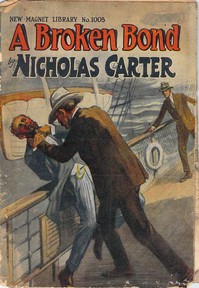
A Broken Bond; Or, The Man Without Morals — Context and Discussion
(0 User reviews)
1031
Project Gutenberg
2020
Not confirmed
Detective and mystery stories; Dime novels; Popular literature
Readers of public-domain and historical texts
Project Gutenberg digital edition
en
Edition facts
Words
62,426
Reading time
272 min
Text sections
54
The source record for A Broken Bond; Or, The Man Without Morals — Context and Discussion measures this digital text at 62,426 words, 4 hr 32 min estimated reading time, and 54 detected text sections.
The text analysis averages about 16.9 words per sentence, while the detected sections provide another way to judge how the source is divided.
Project Gutenberg metadata also associates the work with “Detective and mystery stories,” connecting these edition facts with the source record’s subject description.
Source:
Project Gutenberg record #63143
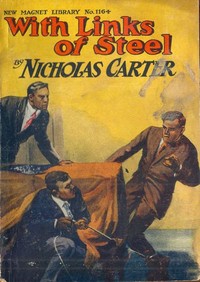
In this Nick Carter dime novel, the detective stalks a madman who attempts murder with a hypodermic syringe. The narrative hinges on a substituted poison, a fire escape stakeout, and a hypnotic spell, with Carter's methodical patience contrasted against the killer's erratic violence.
Editorial Edition Score
4.8/5
★★★★★
★★★★★
Calculated from edition completeness, EPUB availability, text structure and catalogue metadata. Not a user rating.
How this score is calculated
- Description quality20 pts
- Title & short description10 pts
- Source metadata20 pts
- Text length15 pts
- Chapters / structure15 pts
- EPUB file integrity20 pts
Total of 100 points, scaled to a 2.5-5.0 range. Editions with an empty description or a missing EPUB file are not scored.
Edition quality
Read the Text
ong, lean figure. Snuggled against his right shoulder was a rifle, and the bearded face beneath the broad-brimmed panama was turned toward the roadway below. The hot sun beat down remorselessly, and its blinding rays were reflected from the rocks. Perspiration poured down the man’s face, and now and then he moved impatiently to brush away some buzzing insect. His head was raised slightly above the level of the rock, and from his point of vantage a splendid panorama spread out beneath him.
To his left lay the mountains, blue, remote, and full of rugged dignity all their own. To his right, a fertile South American valley revealed itself in the shimmering distance. Occasionally, as a light puff of wind came up from the lowlands, it brought with it the dull, heavy noise of an engine at work.
Half an hour passed, and then the first sign of life was revealed in the roadway below. There appeared round a bend a long line of mules, each of them burdened with two big packs. In front of the train of mules walked a white man clad in dingy overalls.
The figure crouching behind the rock moved slightly and seemed to grow tense and expectant, while the eyes in the bearded face glinted as they peered down at the road.
Nothing happened, however. The mules plodded on, with their leader striding away ahead of them, and the lonely sentinel watched them until they had passed down the road and had vanished below the level of the rise which led them on to the plains.
“He ought to be coming soon now.”
The man spoke aloud, and there was a curious, metallic sound in his rasping voice.
Ten minutes passed, and then the clear, drumming sound of a horse’s hoofs came to him, and presently around the same jagged spur there appeared the figure of a man on horseback. He was riding along at a good pace, but the reins were lying loosely across the horse’s neck, and the animal was picking its way unguided down the rough surface of the road. Evidently it was on a familiar trail.
At the sight, the lurking figure grew tenser still, and the sound of a low growl, almost animal-like in character, might have been heard. Slowly the rifle was nestled closer to the shoulder. The panama hat, being too conspicuous, was pulled off and dropped behind him, after which the bare, rather bald head was lowered until the right cheek touched the stock of the gun. The left eye was closed, and the right sighted along the barrel, which at the same time was shifted, following the man on horseback.
A few moments passed, during which the down-pointed muzzle shifted like a spy-glass, following the moving object. Then——
Crack! Into the still air a blue puff of smoke rose and hung for a moment above the rock. The drone of the bullet sounded clearly down the edge of the slope as the deadly missile hurled itself toward its mark. A quick cry came up from the roadway, and the weapon was stealthily withdrawn.
Quickly, however, the man behind the rock peered down, but when he did so he saw that blind chance had stepped in and thwarted him. The horse had apparently stumbled on a loose rock just as the shot was fired, and had reared back slightly to recover its footing; therefore, it was into the animal’s soft, rounded neck that the heavy bullet had bored its way, and not into the more precious target at which it had been aimed.
The creature was now lying in the roadway, and the convulsive movements of its limbs could be seen dimly through the little cloud of dust which had been raised by its fall.
The man on the horse’s back had been hurled in a heap by the side of the road, but as his would-be murderer watched, he saw him rise to his feet and stare up in the general direction of the rock from which the shot had been fired. Warned by that movement, the skulker swiftly jerked his head back and crouched still lower in his place.
“Curse him!” the hard voice grated. “He always has the fiend’s own luck!”
Grasping his rifle and hat, but still keeping on hands and knees, he began instinctively to crawl away under cover of the rock. He had gone no more than a yard, though, before he paused irresolutely and his fingers sought his belt.
The opening chapter, “A Shot from Ambush,” immediately establishes the story’s reliance on physical danger and surveillance. Nick Carter, the detective, is shown staking out a room, hiding behind a bathroom door to witness an attempted murder. The excerpt reveals a key detail: Carter has already substituted water for the deadly charge in a hypodermic syringe, a quiet intervention that sets the stage for the drama. The narrative voice is brisk, favoring action over introspection, and the setting—a darkened hotel room with a connecting door—creates a claustrophobic arena for the confrontation between the detective, the would-be victim Crawford, and the madman Stone.
A Detective’s Calculated Risks
Nick Carter’s method in this story is defined by patience and physical concealment. He enters Crawford’s room and waits behind a door, listening to the heavy breathing of the sleeping man. The detective acknowledges the risk: if Crawford wakes and mistakes him for a burglar, “it will mess things up hopelessly.” This moment reveals Carter’s reliance on timing and his willingness to let a crime nearly unfold under his watch. He refrains from intervening immediately, even when Stone attacks Crawford, because he wants to witness the act. The narrative emphasizes his control—he has already “pulled Stone’s fangs” by rendering the syringe harmless—but also his awareness that a madman might discard the scientific weapon and resort to brute force. The tension comes from Carter’s calculated gamble: he trusts his preparation but stays ready to leap.
The Madman’s Method and the Hypodermic
The attempted murder relies on a hypodermic syringe, described as part of “a highly scientific crime.” Doctor Follansbee originally placed a “mysterious and deadly charge” in the syringe, which Carter replaces with water. The excerpt shows Stone using a vial and sponge, pressing the sponge over Crawford’s “bearded lips and nostrils.” The method is clinical yet intimate: Stone bends over the bed, and Crawford, waking, murmurs “Jimmy!”—a name that suggests a former bond. The narrative contrasts Stone’s “suppressed, nervous breathing” with Crawford’s trusting recognition. The hypodermic itself is never used in the scene; instead, the sponge becomes the weapon. This substitution of tools hints at the story’s interest in the gap between scientific planning and messy reality. The detective’s intervention is invisible, a quiet swap that turns a lethal instrument into a prop.
Voice and Structure in the Dime Novel
The prose is lean and functional, with short paragraphs and frequent shifts in focus. The narrator stays close to Nick’s perspective, noting his thoughts in italics: “Let’s hope our friend Crawford is a sound sleeper.” Dialogue is sparse; the only spoken word in the excerpt is Crawford’s “Jimmy!” The action is described in physical terms—Stone’s “lean, angular form,” the “subdued light from the corridor,” the “creak” of bed springs. The chapter titles, such as “A Shot from Ambush” and “The Hypodermic,” telegraph key events. The structure relies on a chain of narrow escapes and last-minute interventions, typical of the dime-novel format. The excerpt ends with Crawford’s “convulsive movement” and a sigh, then unconsciousness, leaving the reader to wonder whether the water-filled syringe will later be discovered. The story’s rhythm is built on such cliffhangers, each chapter advancing the plot through physical confrontation rather than deduction.
Readers should attend to the recurring motif of bonds—broken, mended, or strained—that runs through the chapter titles. The relationship between Crawford and Stone, hinted at by the word “comrades” and the affectionate “Jimmy,” may be central to the plot. The story rewards attention to small details: the substituted water, the fire escape mentioned in a chapter title, and the hypnotic spell that appears later. These elements suggest a narrative that values both scientific gadgetry and human psychology, even within the constraints of the dime-novel form.
Reading about Carter’s patient stakeout, I recalled a late night with At the Time Appointed — that same suspended quiet, waiting for a door to open. This detective’s steady watch feels less like action and more like remembering a train platform in fog, where someone else’s patience becomes your own. It’s odd how stillness carries the plot. At the Time Appointed — Story, Setting & Ideas
There are no reviews for this eBook.
There are no comments for this eBook.
Reader reflection
How will you remember this book?
Save your reaction, strongest insight, and memorable passage.
Your progress
0
/
10
2
Did this book hold your interest?
3
Is this a title you would suggest to others?
4
How demanding did the text feel?
5
Did the book deliver what you hoped for?
6
Would you start a conversation about this book?
7
What did you think about the pace?
8
Could you apply anything you learned?
9
What is the main idea you are taking away?
10