1

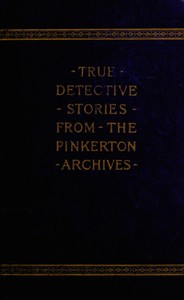
True Detective Stories from the Archives of the Pinkertons — Story, Setting & Ideas
(0 User reviews)
902
Project Gutenberg
2010
Not confirmed
Detective and mystery stories, American; Crime -- United States; Criminals -- United States
Readers of public-domain and historical texts
Project Gutenberg digital edition
en
Edition facts
Words
39,647
Reading time
173 min
Text sections
5
The source record for True Detective Stories from the Archives of the Pinkertons — Story, Setting & Ideas measures this digital text at 39,647 words, 2 hr 53 min estimated reading time, and 5 detected text sections.
The text analysis averages about 25.1 words per sentence, while the detected sections provide another way to judge how the source is divided.
Project Gutenberg metadata also associates the work with “Detective and mystery stories, American,” connecting these edition facts with the source record’s subject description.
Source:
Project Gutenberg record #33922
Cleveland Moffett's collection of Pinkerton cases from the 1870s-1890s, including the Northampton Bank robbery, Susquehanna Express heist, and the destruction of the Reno gang, with detailed accounts of detective methods and the mundane realities of criminal investigation.
Editorial Edition Score
4.7/5
★★★★★
★★★★★
Calculated from edition completeness, EPUB availability, text structure and catalogue metadata. Not a user rating.
How this score is calculated
- Description quality20 pts
- Title & short description10 pts
- Source metadata20 pts
- Text length15 pts
- Chapters / structure15 pts
- EPUB file integrity20 pts
Total of 100 points, scaled to a 2.5-5.0 range. Editions with an empty description or a missing EPUB file are not scored.
Edition quality
Read the Text
Whittelsey was the cashier of the Northampton National Bank, and was known to have in his possession the keys of the bank building and the combination to the bank vault. The five men entered the house noiselessly, with the aid of false keys, previously prepared. Passing up-stairs to the sleeping-apartments, they overpowered seven inmates of the house, gagging and binding them so that resistance or alarm was impossible. These were Mr. Whittelsey and his wife, Mr. and Mrs. T. B. Cutler, Miss Mattie White, Miss Benton, and a servant-girl.
The bedroom of Mr. and Mrs. Whittelsey was entered by two men who seemed to be leaders of the band. One wore a long linen duster buttoned nearly to the knees, also gloves and overshoes; the other wore a jacket and overalls. Both men had their faces concealed behind masks, and one of them carried a dark-lantern. On entering the room the two men went directly to the bed, one standing on either side, and handcuffed Mr. Whittelsey and his wife. Both carried revolvers. The proceedings were much the same in the other rooms.
After some delay and whispered consultation, the robbers ordered the five women to get up and dress. When they had done so, they were roped together by ankles and wrists, and taken into a small room, where they were kept under guard by one of the band. Mr. Cutler also was imprisoned in the same way. Then the two leaders devoted themselves to Mr. Whittelsey. They told him plainly that they had come for the keys of the bank and the combination of the vault, and that they would "make it hot" for him unless he gave them what they wanted. Mr. Whittelsey replied that it was useless to attempt to break into the bank, as the locks were too strong for their efforts and he would not betray his trust. At this the man in the linen duster shrugged his shoulders and said they would see about that.
Mr. Whittelsey was then taken downstairs, and again summoned to surrender the keys. Again he refused. At this the man in the overalls put his hand in the cashier's trousers-pocket and drew forth a key.
"Is this the key to the bank?" he asked.
"Yes, it is," answered the cashier, hoping to gain time.
"You lie," said the robber, with threatening gesture, at the same time trying the key in the lock of the front door of the house, which it turned.
"Don't hit him yet," said the other; "he is sick." Then he asked Mr. Whittelsey if he wanted a drink of brandy. Mr. Whittelsey shook his head no. Then the man in the linen duster renewed his demands. He wanted the combination of the vault. Mr. Whittelsey gave him some figures, which the robber wrote down on a piece of paper. These were for the outer door of the vault. He demanded the combination for the inner door, and Mr. Whittelsey gave him other figures. Having written these down also, the robber came close to his prisoner and said, "Will you swear these figures are correct?"
"I will," answered Mr. Whittelsey.
"You are lying again. If they are correct, let's hear you repeat them."
The cashier could not do this, and so disclosed that the figures were not the right ones.
"See, Number One," said the robber, addressing his comrade, "we're wasting time; we'll have to teach him to stop lying."
As he spoke he struck the sharp point of his lead-pencil into Mr. Whittelsey's face so violently as to make a wound, and followed this with several blows on the body.
"Will you tell us now?" he asked.
Mr. Whittelsey kept silent. Then both men came at him, wringing his ears, shaking him by the throat, hurling him to the floor, and pounding their knees into his chest. For three hours this torture was continued. More than once the ruffians placed their revolvers at Mr. Whittelsey's head, declaring they would blow his brains out unless he yielded. Finally he did yield; the suffering was too great; the supreme instinct of self-preservation asserted itself. Toward four o'clock in the morning, bruised from head to foot, and worn beyond further resistance, he surrendered the keys, and revealed the true combination of the vault.
Then the robbers went away, leaving two of their associates to watch over the prisoners. One of the band, before his departure, did not disdain to search Mr. Whittelsey's clothes and take his watch and chain and fourteen dollars in money. The last of the band remained in the house until six o'clock; and it was an hour later before Mr. Whittelsey succeeded in freeing himself from his bonds.
The Northampton Bank robbery opens with a precise, almost clinical account of five masked men entering a cashier's home at midnight on January 25, 1876. The narrative dwells on the robbers' preparations—false keys, a dark-lantern, handcuffs—and the systematic binding of seven household members. This attention to procedural detail, rather than dramatic tension, sets the tone for the collection. Moffett, drawing on Pinkerton archives, presents crime as a series of logistical problems to be solved, not a mystery to be savored.
Readers should note how the author interweaves specific dates, names, and physical descriptions (a linen duster buttoned nearly to the knees, overshoes) with the detectives' later reasoning. The opening case establishes a pattern: the crime itself is recounted swiftly, while the bulk of each story follows the painstaking, often frustrating work of detection.
The Detective's Unromantic Reality
Midway through the collection, Moffett pauses to correct popular misconceptions about detective work. In the Susquehanna Express case, he writes that “false beards and mustaches, goggles and lightning changes of clothing, are never heard of except in the pages of badly informed story-writers.” Instead, detectives like Frank Murray simply “assumed the characters and general style of the persons they were thrown with.” This insistence on the mundane—sporting tastes, casual conversation in saloons—grounds the narratives in a world of patient legwork and dead ends.
The text repeatedly emphasizes the role of chance and misdirection. Detectives spend weeks chasing a suspect named “Butch” McCoy across several cities, only to learn he was in Galesburg all along. Another promising lead—a free-pass holder who might have seen the stolen valise—turns out to be an advertising solicitor for the very newspaper that would have published the story. Moffett’s accounts are filled with such anticlimaxes, making the eventual captures feel earned rather than inevitable.
The Weight of Physical Evidence
Moffett’s narratives hinge on tangible objects: keys, valises, fragments of drafts. In the Northampton case, the robbers’ false keys and the cashier’s refusal to surrender the vault combination drive the action. Later, a torn piece of a bank draft becomes the central clue in the Susquehanna robbery, preserved in a conductor’s valise. The author describes how detectives “traced” this fragment through multiple hands, relying on its physical presence rather than eyewitness testimony.
This focus on material evidence extends to the criminals themselves. The Reno gang’s destruction is recounted with a catalog of their hideouts and stolen goods. Moffett rarely speculates on motive; instead, he reports what was found, where, and by whom. The result is a collection that reads like a case file—dry in places, but rich in forensic detail that rewards careful attention.
Women as Leads and Liabilities
In a striking aside, Moffett notes that detectives “paid particular regard in the preliminary inquiries to the possibility of love-affairs; for thieves, even more than honest men, are swayed in their lives by the tender passion, and are often brought to justice through the agency of women.” This observation appears in the context of the Susquehanna investigation, where the detectives’ search for a suspect named McCoy involves tracing his romantic connections.
Yet women in these stories are rarely active participants. They appear as victims (the bound women in the Northampton house), as sources of information (often unnamed), or as potential weaknesses in a criminal’s life. The servant-girl, Miss Mattie White, and Miss Benton are listed among the captives but given no further role. Moffett’s treatment reflects the era’s assumptions, but also underscores how the Pinkerton method relied on social networks—including those formed by affection—to close a case.
The Archive as Narrative Frame
Moffett’s title promises stories “from the Archives of the Pinkertons,” and the text bears the marks of its source material. Each account begins with a date and location, as if pulled from a ledger. The prose is efficient, favoring verbs like “entered,” “overpowered,” “traced,” and “captured.” There is little embellishment; even the most dramatic moments—a masked intruder handcuffing a couple in bed—are described with the same flatness as a detective’s report.
This archival quality shapes the reader’s experience. The stories do not build suspense through withheld information; instead, they present facts in chronological order, often revealing the outcome early. The pleasure lies not in whodunit, but in how the detectives pieced together what happened. Readers should approach these tales as historical documents first, entertainment second—a window into late-19th-century policing, with all its biases, breakthroughs, and bureaucratic tedium.
Moffett’s collection rewards readers who attend to the small details: the false key that opens a door, the torn draft fragment that convicts a murderer, the casual remark that leads to a capture. These are not polished detective stories in the modern sense, but raw materials from which such stories are built. For those interested in the history of criminal investigation or the Pinkerton agency’s methods, this volume offers a rare, unvarnished look at the work behind the legend.
That rainy afternoon, the Pinkertons’ patient ledger-work felt less like adventure than quiet arithmetic—stakeouts measured in sore feet, not gunfire. It made me crave something further afield, where mystery wore a different skin. The stacks obliged with Peter the Brazen: A Mystery Story of Modern China — Context and Discussion, and I followed the scent of another era’s fog, half-satisfied with the change of scenery.
There are no reviews for this eBook.
There are no comments for this eBook.
Reader reflection
How did this book work for you?
Your answers remain private and are stored only in this browser.
Your progress
0
/
10
2
How did the book work for you overall?
3
Would you pass this book on to a friend?
4
Did the language feel accessible?
5
What did you think about the pace?
6
Which element worked best for you?
7
Did the book give you something worth debating?
8
Did any part of the book stay with you emotionally?
9
In one sentence, what did you learn?
10