1

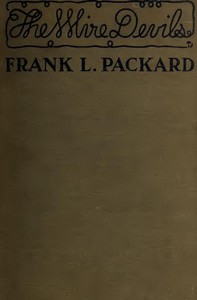
The Wire Devils — Text and Context
(0 User reviews)
649
Project Gutenberg
2016
Not confirmed
Detective and mystery stories; Railroad stories; Canadian fiction -- 20th century
Readers of public-domain and historical texts
Project Gutenberg digital edition
en
Edition facts
Words
78,477
Reading time
342 min
Text sections
9
This digital edition of The Wire Devils — Text and Context is described by source-level measurements including 78,477 words, 5 hr 42 min estimated reading time, and 9 detected text sections.
The text analysis averages about 17.1 words per sentence, while the detected sections provide another way to judge how the source is divided.
Project Gutenberg metadata also associates the work with “Detective and mystery stories,” connecting these edition facts with the source record’s subject description.
Source:
Project Gutenberg record #52084
Frank L. Packard's 1918 mystery collection follows the Hawk, a master criminal who infiltrates a gang of railroad thieves. Through precise diction, sensory-rich descriptions of trains and stations, and a protagonist who switches identities and clothes, the stories reveal a world of codes, skeleton keys, and stolen diamonds.
Editorial Edition Score
4.7/5
★★★★★
★★★★★
Calculated from edition completeness, EPUB availability, text structure and catalogue metadata. Not a user rating.
How this score is calculated
- Description quality20 pts
- Title & short description10 pts
- Source metadata20 pts
- Text length15 pts
- Chapters / structure15 pts
- EPUB file integrity20 pts
Total of 100 points, scaled to a 2.5-5.0 range. Editions with an empty description or a missing EPUB file are not scored.
Edition quality
Read the Text
man's form, like a black shadow in the darkness, rose from the trackside, and crept to the platform, and along the platform to the station door.
The man bent forward, and the round, white ray of a pocket flashlight played upon the lock. He examined the lock for an instant appraisingly, then drew a bunch of skeleton keys from his pocket, and, selecting one of the number without hesitation, unlocked the door, stepped inside, and closed the door behind him.
The flashlight swept in a circle around the interior of the little station. There were but two rooms—the small waiting room which he had entered, and in which he now stood; and, partitioned off from this, the door open, a still smaller inner room, the agent's office. He moved at once into the latter, and his flashlight, swiftly now, searched around the walls and held upon the clock. It was six minutes to ten.
“Pretty close work!” muttered the man. “Six minutes to wait.”
The ray travelled now over the operator's table, and from the table to the switchboard. He reached out, “cut in” the office circuit, listened for an instant as the sounder began to chatter—then the ray swept over the table again. Under a newspaper, that the day man had apparently flung down at haphazard on leaving the office, he found a pad of telegraph blanks, from which, evidently wary of the consequences of using a pad with its resultant tell-tale impressions on the under sheets, he tore off a sheet and laid it down ready to hand before him.
This done, he nodded complacently, sat down in the operator's chair, tilted the chair back, put his feet up on the table, and coolly picked up the newspaper. It was the evening edition of the Selkirk City Journal, that had presumably been tossed off at the station by a charitable train crew of some late afternoon train out from the city. He held the paper in one hand, the flashlight in the other, scanned the page, which happened to be an inner one, cursorily, turned it over, and suddenly leaned forward a little in his seat. He was staring at the headline at the top right-hand corner of the front page. NOTORIOUS CRIMINAL RELEASED FROM SING SING POLICE ARE WARNED THAT MAN MAY BE IN THIS VICINITY HARRY MAUL, ALIAS THE HAWK, KNOWN TO BE IN THE WEST
The telegraph sounder chattered volubly for an instant, as though to challenge and silence the raucous ticking of the clock, and ended in a splutter of wrath, as it were, at the futility of its attempt. The clock ticked on. There was no other sound. And then the man spoke aloud.
“That's me,” he said. “The Hawk.” The paper rattled in his hand. There was a twisted smile on his lips in the darkness. “I guess I'm pretty well known.”
The Hawk's eyes fixed on the text, and he began to read:
“It is reported that Harry Maul, better known to the police as the Hawk, safe-breaker, forger and thief, one of the cleverest 'gentleman' crooks in the country, who is at large again after a five-years' penitentiary term, is somewhere in the West.
“The crime wave that has recently been sweeping over Selkirk City and its vicinity, and particularly the daring and, in too many cases, successful outrages with which the railroad officials and detectives have been called upon to cope of late, may, as a very plausible theory, have lured the Hawk here as to a promising field in which to resume his criminal operations. Certain it is that, while we have been the victims of a band of mysterious desperadoes for some time past, the last week or so has seen a very marked increase in the number of crimes that have been committed—a significant coincidence with the Hawk's release from Sing Sing.
“A twenty-thousand-dollar diamond necklace was stolen from a private car two nights ago; there was an express car robbery on Monday of this week; and a sleeping car was thoroughly and systematically looted the night before. True, it is mere conjecture to connect the Hawk with these in any way, since the gang that has been operating in this neighbourhood has proved itself quite capable of all and more than this without any outside and highly specialised assistance, and it would appear is in no whit inferior in resource and devilish ingenuity to the best, or worst, that Sing Sing has to offer in the shape of this so-called Hawk; but, out of conjecture, one question naturally suggests itself.
The opening of The Wire Devils immediately establishes a world of precise, sensory detail. The narrative begins not with a character but with two switch lights twinkling at either end of a siding, then slowly builds a soundscape: a low muttering that grows into a sustained roar, the quick gasps of a freight engine, and the clanking, grinding, screaming of cars. This attention to the physical texture of railroading—the polished silver ribbons of the metals under a headlight, the sparks from the fire-box door—is not mere atmosphere; it is the stage for a story where every detail of a train, a station, or a lock can be a clue or a trap. The author's diction is exact: the ten-wheeler 'stormed by, coughing the sparks heavenward,' and the tail-lights 'winked like mischievous little red eyes.'
The Hawk's Double Life
The protagonist, known only as the Hawk, operates as a thief who simultaneously preys upon and infiltrates a criminal gang. The excerpts show him changing clothes rapidly—from a light-grey suit to a darker material—and transferring his automatic and skeleton keys. His trunk contains a false tray with 'unhallowed contents,' including diamonds robbed from the Fast Mail. The Hawk's internal voice is cool and self-aware: he muses that he would 'go out like you'd snuff a candle' if the gang ever caught him, and notes they are getting 'querulous.' This duality is reinforced by his ability to blend in as an 'interested fellow traveller' while eavesdropping on a Frenchman's plea for a special train.
Diction of Deception
Packard's word choices consistently emphasize concealment and observation. The Hawk's flashlight 'played upon the lock' as he examines it 'appraisingly.' When he sees the Frenchman's pocketbook, his eyes 'aimlessly sought the toes of his boots'—a deliberate gesture of feigned disinterest. The narrative uses verbs of stealth: the Hawk 'crept to the platform,' 'sucked in his breath softly,' and 'quietly left the room.' Even the gang's operations are described in terms of weaving: the chapter titles include 'Threads in the Web' and 'Birds of a Feather.' The language creates a world where every action is calculated and every glance is a potential giveaway.
Setting as Silent Character
The Rocky Mountain setting is not just backdrop but an active element in the plot. The opening describes 'the spell of the brooding mountains' lying over 'desolate, butte-broken country.' Later, the superintendent explains that traffic in the mountains is 'already demoralised,' preventing the Frenchman from catching his connection. The isolation of stations like Bald Creek—'little more than a shanty' with no night operator—creates opportunities for theft. The author uses the landscape to build tension: the train emerges from behind an intervening butte, and the silence after it passes is 'that brooding silence again.' The physical environment dictates what is possible for both the Hawk and his pursuers.
The Currency of Crime
Money and valuables are described with a thief's appraising eye. The Frenchman's pocketbook is a 'well-filled' one with 'a fat wad of bills' whose denominations are 'of a large and extremely interesting nature.' The Hawk's diamonds 'trickle out into the palm of his hand' as he inventories his haul. But the stories also feature counterfeits: the second chapter is titled 'The Ten-Dollar Counterfeit Note.' The Hawk's skeleton keys and his ability to open any lock suggest that the real currency of this world is not cash but access. The author's focus on the physical details of theft—the feel of a lock, the weight of a pocketbook, the gleam of stones—grounds the criminal enterprise in tangible reality.
Readers approaching The Wire Devils should attend to the interplay between the Hawk's internal calculations and the external details of trains, locks, and disguises. Packard builds suspense not through dramatic reveals but through the accumulation of precise observations—a change of suit, a glance at boots, the sound of a train fading into silence. The stories reward attention to the physical world and the small choices that reveal a character's true intentions.
Reading about the Hawk slipping through crowded stations, I remembered my father’s old leather valise, its brass lock always a mystery. The codes and keys felt like his quiet world. Then The Diamond Master — Reading Companion brought back that same ache—another sort of gleaming, locked-away life, where a man’s disguise was his last honest thing.
There are no reviews for this eBook.
There are no comments for this eBook.
Reader reflection
How did this book work for you?
Your answers remain private and are stored only in this browser.
Your progress
0
/
10
2
Was reading this book enjoyable?
3
How likely are you to recommend this book?
4
Did the language feel accessible?
5
Do you expect to return to this book?
6
How useful were the ideas in this book?
7
How closely did the book connect with your experience?
8
Would this book work well in a reading group?
9
In one sentence, what did you learn?
10