1

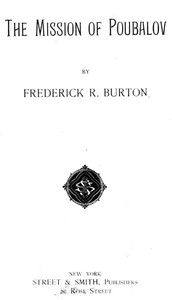
The Mission of Poubalov — A Reader’s Guide
(0 User reviews)
1155
Project Gutenberg
2014
Not confirmed
New York (N.Y.) -- Fiction; Detective and mystery stories; Boston (Mass.) -- Fiction; Missing persons -- Fiction; Fiancées -- Fiction
Readers of public-domain and historical texts
Project Gutenberg digital edition
en
Edition facts
Words
78,085
Reading time
340 min
Text sections
8
For The Mission of Poubalov — A Reader’s Guide, the stored edition analysis reports 78,085 words, 5 hr 40 min estimated reading time, and 8 detected text sections.
The text analysis averages about 17.0 words per sentence, while the detected sections provide another way to judge how the source is divided.
Project Gutenberg metadata also associates the work with “New York (N.Y.) -- Fiction,” connecting these edition facts with the source record’s subject description.
Source:
Project Gutenberg record #46774
Frederick R. Burton's mystery novel follows Clara Hilman's search for her missing fiancé Ivan Strobel, involving a Russian agent named Poubalov and a tailor named Litizki. The narrative shifts between Clara's determined perspective and the elusive movements of Poubalov, with a notable change in pace from leisurely domestic scenes to tense surveillance sequences.
Editorial Edition Score
4.7/5
★★★★★
★★★★★
Calculated from edition completeness, EPUB availability, text structure and catalogue metadata. Not a user rating.
How this score is calculated
- Description quality20 pts
- Title & short description10 pts
- Source metadata20 pts
- Text length15 pts
- Chapters / structure15 pts
- EPUB file integrity20 pts
Total of 100 points, scaled to a 2.5-5.0 range. Editions with an empty description or a missing EPUB file are not scored.
Edition quality
Read the Text
THEIR WEDDING MORNING.
Ivan pulled aside the curtain and looked up at the sky. It was as clear as crystal, as blue as the eyes of his beloved, the promise fulfilled of a perfect day. On a window cornice across the street a tiny bird perked his head toward the sun and chirped noisily. To a lively imagination kindled by fond anticipations the twittering of the bird would have seemed like music. So it was to Ivan. His heart responded with unformed melodies, and some of their stray notes found their way humming to his throat as he hastened his toilet.
A long process it was in spite of his haste. Every outer garment, though but yesterday brought by the tailor, had to be brushed with exquisite care, and when it came to adjusting his tie, what with finding in the light of this beautiful morning that not one of the numerous assortment seemed to be bright enough for the occasion, and having rejected all in turn, and having selected one at last that might be made to do, and having found the knot and loosed it--well, time had passed, and under ordinary circumstances patience might have gone with it. Ordinary, the circumstances were not, and if they had been I presume any tie could have, and would have been thrown together in a shape not less pleasing than that which finally caused him to turn from the mirror in cheerful despair and ring for breakfast.
Mrs. White was prompt in responding to the summons, for she had been expecting it with quivering anxiety for the last half hour. Good soul! With eggs at thirty-five cents a dozen she nevertheless plunged two in hot water every four minutes, in order that her lodger might not trace the slightest sense of disappointment, on this eventful day, to her.
"I do hope his last breakfast here will be a pleasant one," she said when her daughter protested against the extravagance.
There was certainly nothing in the plain breakfast to call for criticism. Ivan might not have noticed it if there had been, for his thoughts were elsewhere, and his emotions were stirred by causes at once more delicate and more powerful than appetite; but Mrs. White was probably in the right. It would have been a pity to permit any chance of a jarring note however slight in the harmony that pervaded his being.
Ivan greeted his landlady gayly, and attacked his meal as if there were no such thing as love in the world, love that makes man melancholy, that destroys the delights of good living, that drives him to the production of gloomy wails in more or less eccentric verse. There was no such love for him. Out of the storm and stress of an eventful career, in which misfortune had rained its blows upon him with undue severity, love had arisen like the comforting glow of a home hearth fire, and it shone upon his exile with naught in its beams but serenity and peace. Ivan was happy.
Breakfast was hardly begun when Mrs. White again appeared.
"There's a gentleman to see you, Mr. Strobel," she said hesitatingly; "I didn't like to disturb you, but he seemed very anxious, and so I said I would see if you were at home."
She laid a card upon the breakfast table and waited.
Ivan glanced at it and frowned. So, there must needs be a cloud upon this day to remind him, as if he needed it! how surely the sun of happiness was shining for him. Alexander Poubalov! What could he be doing in America, and what could have led him to call at just this juncture? Bah! there could be no significance in it, nothing but a memory of troublous experiences could be evoked by his presence, nothing connected with that past could possibly intervene now between him and the new life upon which he was joyously entering.
Mrs. White was sorely distressed, for she saw that her lodger was disturbed, and in her motherly heart she wished that she had told the stranger below one of those white lies that have come to be regarded as not sinful in that they effect at least a postponement of evil. She might have said that Mr. Strobel was engaged, or that he had given up his room a week before. Both statements would have been true enough for the Recording Angel's book, goodness knows!
"If you had only just gone, or if he had come an hour later," she murmured plaintively.
"Oh, there's nothing the matter," cried Ivan, lightly; "I was simply wondering what in the world he could want with me. I haven't seen him for five years. Show him up, please."
The novel opens with Ivan Strobel fussing over his tie on his wedding morning, a scene rendered in leisurely, almost comic detail. The narrative voice lingers on his fastidiousness—brushing garments, rejecting ties—before Mrs. White’s anxious egg-boiling punctures the idyll. This domestic rhythm soon gives way to a faster, more clipped style as Clara Hilman takes over the investigation, tracking Poubalov through hotel registers and tense encounters. The shift in pace mirrors the move from private anticipation to public danger.
From Domestic Comedy to Surveillance
The opening chapter’s unhurried tone—Ivan’s toilet, the landlady’s eggs—creates a false sense of security. Once Clara begins her search, the prose tightens. Sentences grow shorter, action verbs multiply: “He was walking very rapidly,” “he went slowly down the avenue.” The bird that chirped in chapter one is replaced by Litizki’s watchful eyes. This change in pace is not merely stylistic; it signals a shift from interior feeling to external threat. The reader, like Clara, must adjust to a world where every glance and register entry carries weight.
Voice and Silence: Clara’s Restraint
Clara’s dialogue is marked by deliberate calm. When Litizki confesses his mistake, she replies, “Don’t think of it,” and later thanks him with “You are a faithful friend.” Her voice remains measured even when Lizzie White greets her with “hard, resentful tone.” The narrative withholds Clara’s inner turmoil, letting her actions speak. This restraint contrasts with the earlier, more effusive descriptions of Ivan’s emotions. The shift in narrative voice—from Ivan’s unformed melodies to Clara’s clipped questions—reflects her role as the story’s active investigator.
Recurring Details: Registers and Watchers
Hotel registers appear twice in the excerpts: Poubalov examines one, and Mr. Pembroke notes that Clara’s name was “on the book.” These mundane objects become clues, linking characters across space. Similarly, the motif of watching—Litizki “hung around where I could keep all the doors in view,” Clara feels “more perturbation” as she waits—creates a network of surveillance. The narrative voice treats these details with matter-of-fact precision, never over-explaining their significance. This restraint keeps the reader alert to small, telling actions.
Burton’s novel rewards attention to shifts in tempo and tone. The early domestic comedy gives way to a taut, observational style as Clara navigates a world of hidden watchers and cryptic registers. Readers may find that the story’s suspense lies less in dramatic reveals than in the quiet accumulation of detail—a glance, a hesitation, a name on a page. Approach the text as a puzzle of voices and pauses, where even a landlady’s egg-boiling can signal a change in the air.
Something about Clara’s steady searching reminded me of a quieter kind of bargain—where the waiting itself becomes the story. I found the same lingering pull in Old Broadbrim Into the Heart of Australia or, A Strange Bargain and Its Consequences — Context and Discussion, that odd hush between decisions, the weight of what’s unsaid. Both left me sitting still afterwards, thinking about promises we keep without quite knowing why.
There are no reviews for this eBook.
There are no comments for this eBook.
Reader reflection
How will you remember this book?
Save your reaction, strongest insight, and memorable passage.
Your progress
0
/
10
2
Did this book hold your interest?
3
Would you recommend this book to another reader?
4
Did the language feel accessible?
5
What did you think about the pace?
6
Did you gain anything practical from the text?
7
How understandable was the text?
8
How closely did the book connect with your experience?
9
What changed or sharpened your thinking?
10