1

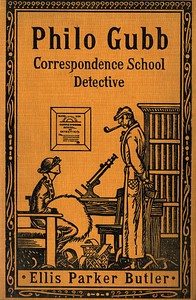
Philo Gubb, Correspondence-School Detective — Themes and Context
(0 User reviews)
568
Project Gutenberg
2009
Not confirmed
Detective and mystery stories
Readers of public-domain and historical texts
Project Gutenberg digital edition
en
Edition facts
Words
90,582
Reading time
394 min
Text sections
11
The source record for Philo Gubb, Correspondence-School Detective — Themes and Context measures this digital text at 90,582 words, 6 hr 34 min estimated reading time, and 11 detected text sections.
The text analysis averages about 12.7 words per sentence, while the detected sections provide another way to judge how the source is divided.
Project Gutenberg metadata also associates the work with “Detective and mystery stories,” connecting these edition facts with the source record’s subject description.
Source:
Project Gutenberg record #29721
Philo Gubb, a paper-hanger turned detective via correspondence school, stumbles through absurd cases in Riverbank. The humor derives from his literal-minded application of textbook methods and the gap between his self-image and reality.
Editorial Edition Score
4.9/5
★★★★★
★★★★★
Calculated from edition completeness, EPUB availability, text structure and catalogue metadata. Not a user rating.
How this score is calculated
- Description quality20 pts
- Title & short description10 pts
- Source metadata20 pts
- Text length15 pts
- Chapters / structure15 pts
- EPUB file integrity20 pts
Total of 100 points, scaled to a 2.5-5.0 range. Editions with an empty description or a missing EPUB file are not scored.
Edition quality
Read the Text
Gubb was tall and gaunt, reminding one of a modern Don Quixote or a human flamingo; by nature Mr. Gubb was the gentlest and most simple-minded of men. Now, bending his long, angular body almost double, he placed his eye to a crack in the door panel and stared into the room. Within, just out of the limited area of Mr. Gubb's vision, Roscoe Critz paused in his work and listened carefully. He heard the sharp whistle of Mr. Gubb's breath as it cut against the sharp edge of the crack in the panel, and he knew he was being spied upon. He placed his chubby hands on his knees and smiled at the door, while a red flush of triumph spread over his face.
Through the crack in the door Mr. Gubb could see the top of the washstand beside which Mr. Critz was sitting, but he could not see Mr. Critz. As he stared, however, he saw a plump hand appear and pick up, one by one, the articles lying on the washstand. They were: First, seven or eight half shells of English walnuts; second, a rubber shoe heel out of which a piece had been cut; third, a small rubber ball no larger than a pea; fourth, a paper-bound book; and lastly, a large and glittering brick of yellow gold. As the hand withdrew the golden brick, Mr. Gubb pressed his face closer against the door in his effort to see more, and suddenly the door flew open and Mr. Gubb sprawled on his hands and knees on the worn carpet of the bedroom.
"There, now!" said Mr. Critz. "There, now! Serves you right. Hope you hurt chuself!"
Mr. Gubb arose slowly, like a giraffe, and brushed his knees.
"Snoopin' an' sneakin' like that!" said Mr. Critz crossly. "Scarin' me to fits, a'most. How'd I know who 'twas? If you want to come in, why don't you come right in, 'stead of snoopin' an' sneakin' an' fallin' in that way?"
As he talked, Mr. Critz replaced the shells and the rubber heel and the rubber pea and the gold-brick on the washstand. He was a plump little man with a shiny bald head and a white goatee. As he talked, he bent his head down, so that he might look above the glasses of his spectacles; and in spite of his pretended anger he looked like nothing so much as a kindly, benevolent old gentleman--the sort of old gentleman that keeps a small store in a small village and sells writing-paper that smells of soap, and candy sticks out of a glass jar with a glass cover.
"How'd I know but what you was a detective?" he asked, in a gentler tone.
"I am," said Mr. Gubb soberly, seating himself on one of the two beds. "I'm putty near a deteckative, as you might say."
"Ding it all!" said Mr. Critz. "Now I got to go and hunt another room. I can't room with no detective."
"Well, now, Mr. Critz," said Mr. Gubb, "I don't want you should feel that way."
"Knowin' you are a detective makes me all nervous," complained Mr. Critz; "and a man in my business has to have a steady hand, don't he?"
"You ain't told me what your business is," said Mr. Gubb.
"You needn't pretend you don't know," said Mr. Critz. "Any detective that saw that stuff on the washstand would know."
"Well, of course," said Mr. Gubb, "I ain't a full deteckative yet. You can't look for me to guess things as quick as a full deteckative would. Of course that brick sort of looks like a gold-brick--"
"It _is_ a gold-brick," said Mr. Critz.
"Yes," said Mr. Gubb. "But--I don't mean no offense, Mr. Critz--from the way you look--I sort of thought--well, that it was a gold-brick you'd bought."
Mr. Critz turned very red.
"Well, what if I did buy it?" he said. "That ain't any reason I can't sell it, is it? Just because a man buys eggs once--or twice--ain't any reason he shouldn't go into the business of egg-selling, is it? Just because I've bought one or two gold-bricks in my day ain't any reason I shouldn't go to sellin' 'em, is it?"
Mr. Gubb stared at Mr. Critz with unconcealed surprise.
"You ain't,--you ain't a con' man, are you, Mr. Critz?" he asked.
Philo Gubb, a paper-hanger by trade and a detective by correspondence course, is introduced tiptoeing to a bedroom door, placing his eye to a crack in the panel. The narrator describes him as “tall and gaunt, reminding one of a modern Don Quixote or a human flamingo,” and “the gentlest and most simple-minded of men.” This opening establishes a central tension: Gubb’s earnest pursuit of detection is undercut by his physical awkwardness and naivete. The excerpts show him repeatedly misreading situations—believing a murder victim was “progressively murdered by inches” when told he was killed instantly, or paying $1.50 for a telegram that reduces his beloved’s weight by five pounds. The catalog subject “Detective and mystery stories” fits only ironically; the book is a comedy of errors, not a puzzle to be solved.
The Correspondence-School Detective at Work
The title character’s method is shaped entirely by the Rising Sun Detective Agency’s Correspondence School of Detecting. Gubb applies its lessons with rigid literalism. In “The Hard-Boiled Egg,” he spies through a door crack, but his breath whistling against the panel gives him away. Later, he prepares to shadow a man based on a client’s story, only to overhear that the same man has just committed a murder—yet Gubb’s first thought is that he nearly made “a fool of himself” by following the wrong suspect. His training provides a vocabulary (“shadow and trail,” “deteckative”) but no practical judgment. The humor lies in the mismatch between his self-image as a fully graduated professional and his actual incompetence.
Money, Weight, and the Logic of Gubb’s World
The excerpts reveal a peculiar economic and physical logic. Gubb’s love interest, Syrilla, is a side-show fat lady whose weight fluctuates with her diet. A telegram announces she has “given up all cereal diet” and now weighs “only nine hundred and twenty-five pounds.” Gubb calculates the cost of the telegram at “thirty cents a pound.” This numerical precision applied to absurd figures is a recurring pattern. Similarly, a bill for $11,900 in gold-mine stock appears without explanation. The world of Riverbank runs on exaggerated sums and improbable bodily transformations, all treated with deadpan seriousness by Gubb. The catalog’s “general-literature” tag is apt: the book satirizes genre conventions rather than fulfilling them.
Voice and Narration: The Gap Between Gubb and the Reader
Butler’s narration maintains a straight face while describing Gubb’s antics. The contrast between Gubb’s formal, stilted speech (“If you insist to wish to know”) and the colloquial banter of other characters creates comedy. When a loafer calls Gubb “Crazy as a loon!”, Gubb struggles “for a suitably crushing retort.” The illustrations by Rea Irvin, listed in the contents, likely heighten the visual absurdity—one caption reads “In the deteckative line nothing sounds foolish.” The narrative voice never condescends to Gubb, which makes his failures funnier. The reader is always one step ahead, watching Gubb apply textbook rules to a world that refuses to cooperate.
The excerpts suggest a collection of linked stories rather than a novel, with each chapter presenting a new case. Readers should expect episodic adventures, not a single mystery arc. Gubb’s earnestness is the engine of the comedy; his failures are never mean-spirited. The book rewards attention to its verbal and situational irony, and to the way Butler uses detective-story conventions as a framework for farce.
That rainy afternoon, Philo Gubb’s hopeless literalism made me oddly tender toward him—the way we all cling to rules when the world feels slippery. That feeling lingered, and later, almost without deciding, I picked up a book about a suitcase and its secrets. The Million-Dollar Suitcase — Key Ideas to Explore wove a quieter, more wistful thread into the same strange desire to make sense of things, and the rain kept falling, patient and unhurried.
There are no reviews for this eBook.
There are no comments for this eBook.
Reader reflection
Record your reading impressions
A brief reflection can help important ideas stay with you longer.
Your progress
0
/
10
2
Was reading this book enjoyable?
3
Is this a title you would suggest to others?
4
How much effort did this book require?
5
How did the pace of the book feel?
6
Did this book create an emotional response?
7
Did the book deliver what you hoped for?
8
Did you gain anything practical from the text?
9
In one sentence, what did you learn?
10