1

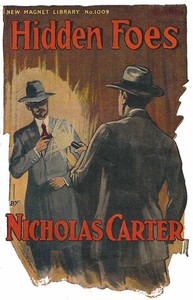
Hidden Foes; Or, A Fatal Miscalculation — Story, Setting & Ideas
(0 User reviews)
295
Project Gutenberg
2020
Not confirmed
Fiction; Detective and mystery stories; Dime novels
Readers of public-domain and historical texts
Project Gutenberg digital edition
en
Edition facts
Words
58,806
Reading time
256 min
Text sections
32
The source record for Hidden Foes; Or, A Fatal Miscalculation — Story, Setting & Ideas measures this digital text at 58,806 words, 4 hr 16 min estimated reading time, and 32 detected text sections.
The text analysis averages about 13.2 words per sentence, while the detected sections provide another way to judge how the source is divided.
Project Gutenberg metadata also associates the work with “Fiction,” connecting these edition facts with the source record’s subject description.
Source:
Project Gutenberg record #62860
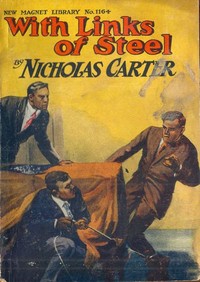
In this Nick Carter dime novel, a masked antagonist uses an electrified wire trap, and detective Chick is rendered unconscious. The narrative shifts between Carter's deductive reasoning and Patsy's stealthy surveillance, with a marathon pursuit through darkened grounds.
Editorial Edition Score
4.8/5
★★★★★
★★★★★
Calculated from edition completeness, EPUB availability, text structure and catalogue metadata. Not a user rating.
How this score is calculated
- Description quality20 pts
- Title & short description10 pts
- Source metadata20 pts
- Text length15 pts
- Chapters / structure15 pts
- EPUB file integrity20 pts
Total of 100 points, scaled to a 2.5-5.0 range. Editions with an empty description or a missing EPUB file are not scored.
Edition quality
Read the Text
A MYSTERIOUS FATALITY.
Nobody had heard the report of a pistol.
There had been no disturbance; in fact, no audible altercation, no startling cry for help, or even a groan of sudden, terrible distress.
The man lay there as motionless, nevertheless, as if felled by a thunderbolt. His life had been snuffed out like the flame of a candle by the fury of a whirlwind. Death had come upon him like a bolt from the blue. By slow degrees his face underwent a change--but it was not the change that ordinarily follows sudden death, that peaceful calm that marks the end of earthly toil and trouble.
Instead, the smoothly shaven skin seemed to shrink and wither slightly over the dead nerves and lifeless muscles, and a singular slaty hue that was hardly perceptible settled around his lips and nostrils, partly dispelling the first deathly pallor. It was as if the blast from a furnace, or the searing touch of a fiery hand, had withered and parched it.
He was a comparatively young man, not over thirty, and he was fashionably clad in a plaid business suit. He was lying flat on his back on the floor of the second-story corridor of a building known as the Waldmere Chambers, in the city of Madison.
Presently the door of one of the several adjoining rooms was opened and a stylish young woman emerged. She was clad for the street, and lingered to lock the door and put the key in her leather hand bag. Then she turned, and her gaze fell upon the prostrate man, several yards away and nearer the broad stairway leading down to the lower floor and the street door.
“Good heavens! Is he drunk?” she gasped, shrinking involuntarily.
She feared to approach him, though her hesitation was only momentary. For she heard the tread of some one on the stairs, obviously that of a man, and she ventured nearer just as the other appeared at the top of the stairs, a well-built, florid man of middle age.
“Oh, Doctor Perry, look here!” she cried excitedly. “What’s the matter with this man? Is he drunk or ill, or what is the----”
“Well, well, I don’t wonder you ask.” Doctor Perry approached and gazed down at him. “I don’t know, Miss Vernon. He appears to be----”
He stopped short; then crouched and raised the man’s arm, dropping it quickly. It fell back upon the floor as if made of clay.
“Heavens!” he exclaimed, rising hurriedly. “The man is dead.”
“Dead!” Miss Vernon echoed, turning pale.
“Stone dead. Do you know him?”
“No. I just came from my rooms to go to lunch and saw him lying here.”
“Did you hear him fall, or any disturbance, or----”
“I heard nothing, Doctor Perry, not a sound.”
“We must call a policeman. I will wait here while you do so. Go down to the street and find an officer.”
“Won’t it be better to telephone? I can do so in a moment.”
“Yes, yes, in that case,” Doctor Perry nodded. “Hasten.”
Miss Vernon ran back and entered her rooms, on the door of which a modest brass plate stated that her business was that of a manicure and ladies’ hairdresser. She ran to a telephone in one of the attractively furnished rooms, crying quickly to the exchange operator:
“Give me the police headquarters. Hurry, please! It’s an emergency case.”
Seated with Chief Gleason in the latter’s private office when the telephone call was received in the outer office was the celebrated American detective, Nicholas Carter, who had arrived in Madison early that morning with two of his assistants, and who then was discussing with the chief the business which had occasioned his visit, the nature of which will presently appear. They were interrupted by a police sergeant, who knocked and entered, saying quickly:
“A man has dropped dead, chief, in a corridor of the Waldmere Chambers. Shall I send the ambulance?”
“What man? Is he known?” Gleason questioned, swinging around in his swivel chair.
“A woman telephoned that the body had just been found. Doctor Perry, the dentist, was watching it while she telephoned. His office is in the Waldmere Chambers. Neither of them knew the dead man.”
“Yes, send the ambulance,” Chief Gleason directed. “You had better go, also, and look into the case. If----”
“One moment,” Nick Carter interrupted. “I think I’ll go with him, chief, if you don’t mind.”
“What need of that? It is merely a case of----”
The masked man in Hidden Foes does not rely on a gun. When Chick grapples him in darkness, the villain drops his revolver and instead uses a wire that delivers a shock like “ten million needles.” The attack is instantaneous: Chick’s muscles relax, he gasps, and falls “as inert as a bag of sand.” This electrified defense is a precise, unusual detail that sets the tone for a story where physical confrontation is as much about technology as about strength.
The narrative voice shifts between Nick Carter’s analytical calm and the raw physicality of his assistants. Carter’s deductions are presented as logical conclusions, while Chick and Patsy operate in a world of shadows, stealth, and sudden violence. The pace accelerates during action sequences, with short sentences and abrupt transitions that mirror the characters’ quick movements.
Electrified Confrontations
The masked man’s weapon is not a conventional firearm but a device that delivers a paralyzing shock. The description emphasizes the sensory experience: “ten million needles” thrust into Chick, followed by “excruciating pain” and immediate unconsciousness. This is not a simple knockout; it is a calculated, almost scientific method of incapacitation. The villain’s confidence—”You have as good a chance of getting me as a hailstone would have on a red-hot stove”—is matched by his preparedness. He raises his arms to avoid being grabbed, then drops his hands to apply the wires. The scene relies on darkness and touch, with both characters dropping their searchlights. The result is a moment of utter vulnerability for the detective, who is left “as inert as a bag of sand.”
Stealth and Surveillance
Patsy Garvan’s approach to the Osgood Hospital is a study in careful movement. He arrives after dark, with “no stars to reveal his stealthy movements.” He uses trees and shrubbery for cover, entering the estate near a corner and stealing around the west wing. The description of the building’s windows—shade lowered, interior shutter closed, but a chink showing a dim light—creates a sense of hidden activity. Patsy’s internal monologue is colloquial: “I must find out, to begin with, whether the blooming sawbones is here.” The narrative shifts between his cautious physical actions and his thoughts, building tension through small details like the reflection of light on a varnished sill. This section contrasts with the violent confrontation in the previous chapter, showing a different kind of detective work based on patience and observation.
Pace and Narrative Rhythm
The story alternates between rapid action and slower, deductive passages. In the fight scene, sentences become short and fragmented: “He leaped while he spoke, and covered the distance with a single bound, dropping his searchlight.” The masked man’s response is equally swift: “dropped his, venting a wolfish snarl.” The pace then slows as the narrator describes the grapple in detail, only to accelerate again with the electric shock. In contrast, Patsy’s surveillance is measured, with longer sentences that track his careful progress. The chapter titles themselves hint at this rhythm: “A Marathon Pursuit” suggests endurance, while “Where the Tide Turned” implies a sudden reversal. The narrative voice remains consistent—third-person, focused on external action—but the tempo changes to match the scene’s demands.
Readers should pay attention to how the story uses darkness and light. Many key scenes occur in near-total blackness, forcing characters to rely on touch and sound. The masked man’s electric weapon is one example; Chick’s leap in the dark is another. The narrative often withholds visual information, creating suspense through what is not seen. This technique, combined with the shifting pace between deduction and action, gives Hidden Foes a distinctive rhythm that rewards close attention to sensory details.
There’s something about that frantic chase through the dark in Hidden Foes that stayed with me long after closing it—the quiet dread, the almost desperate way Patsy keeps watching. It reminded me of the lingering unease I felt with The Saintsbury Affair — A Reader’s Guide. Odd, how a simple trap can echo like that.
There are no reviews for this eBook.
There are no comments for this eBook.
Reader reflection
What did you think of this book?
Answer a few questions and save a private reflection on this device.
Your progress
0
/
10
2
Was reading this book enjoyable?
3
Would you pass this book on to a friend?
4
How easy was the book to follow?
5
Did the book give you something worth debating?
6
Was the book moving at the right speed?
7
Is this a title worth rereading?
8
Did the book offer a fresh perspective?
9
Which lesson or insight stayed with you?
10