1

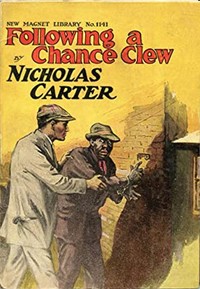
Following a Chance Clew; Or, Nick Carter's Lucky Find — Context and Discussion
(0 User reviews)
119
Project Gutenberg
2021
Not confirmed
Detective and mystery stories; Dime novels; American fiction
Readers of public-domain and historical texts
Project Gutenberg digital edition
en
Edition facts
Words
55,690
Reading time
243 min
Text sections
7
The source record for Following a Chance Clew; Or, Nick Carter's Lucky Find — Context and Discussion measures this digital text at 55,690 words, 4 hr 3 min estimated reading time, and 7 detected text sections.
The text analysis averages about 13.4 words per sentence, while the detected sections provide another way to judge how the source is divided.
Project Gutenberg metadata also associates the work with “Detective and mystery stories,” connecting these edition facts with the source record’s subject description.
Source:
Project Gutenberg record #66708
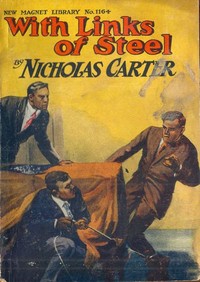
Nick Carter is bound and gagged in a locked room, rescued by a neighbor who descends an airshaft. The detective recovers a clew involving an electric drill and a suspicious pair of doctors, setting up a fast-paced investigation.
Editorial Edition Score
4.7/5
★★★★★
★★★★★
Calculated from edition completeness, EPUB availability, text structure and catalogue metadata. Not a user rating.
How this score is calculated
- Description quality20 pts
- Title & short description10 pts
- Source metadata20 pts
- Text length15 pts
- Chapters / structure15 pts
- EPUB file integrity20 pts
Total of 100 points, scaled to a 2.5-5.0 range. Editions with an empty description or a missing EPUB file are not scored.
Edition quality
Read the Text
sign over the jeweler’s store on Eighth Avenue and stopped to glance critically at the place.
He noticed that the “regulator” indicated midnight.
His thoughts flew back to another midnight earlier in the week, when Lusker’s store had been cleaned out by burglars.
The robbery had been charged to a mysterious crook known as Doc Helstone, who was supposed to be the leader of a clever gang of lawbreakers.
Nick had been asked to break up this gang, which had baffled some of the best men of Inspector McLaughlin’s staff. A proposition had been made to him that day, and he had promised an answer on the morrow.
Probably he would have decided to refuse the job, for he had a lot of work on hand; but, as he strolled up the avenue on that September night, an adventure was waiting for him which was to alter his purpose, and set him upon the track of a remarkable scoundrel.
Lusker’s place was nearly in the middle of a block. As Nick turned his eyes away from the window, he noticed, on the street corner beyond, a group of about a dozen men and women.
There was nothing unusual about them except that they were all looking one way. Their attention had evidently been strongly attracted by something which was taking place on the side street, to the westward.
Suddenly they all hurried in that direction. Other persons, attracted by this movement, joined in it.
All whom Nick could see were hastening toward this center of interest--all, except one man, who was walking the other way.
This man came out of the street wherein the crowd was gathering, and turned up the avenue. Nick saw him for only a moment, and at a considerable distance, but he remembered him.
When Nick came to the street corner, he saw, about forty yards from the avenue, a considerable crowd, upon the downtown side. He quickly made his way to the midst of it.
There he saw a young man kneeling on the sidewalk, and supporting upon his arm the head of a woman.
The man seemed considerably agitated. The woman’s face, indistinct in the dim light, was white and rigid.
“Do you know this woman?” asked Nick, quickly, of the young man, after he had cast a single glance upon the unconscious figure.
“No; I never saw her before.”
“Do you know a tall man with a light brown beard parted in the middle, a dark suit of----”
“Why, that’s the man who has gone to ring for an ambulance,” was the reply. “This lady was with him when she was taken sick.”
Nick did not wait to hear any more. He slipped through the crowd like an eel, and darted away.
He was on the track of the man whom he had seen walking away from the spot to which everybody else was hurrying.
The avenue was brightly lighted, but the man was not in sight. By rapid, clever work, Nick traced him to Forty-first Street, where he had entered a carriage.
A hackman, who had seen this, did not remember ever to have seen the carriage or the driver or the passenger before.
“Was the man looking about for a carriage when you first saw him?” asked Nick.
“No; he knew where to find one,” was the reply.
“Did he give any directions to the driver?”
“He held up his hand in a queer sort of way, and the driver nodded. Nothing was said.”
Evidently the carriage had been waiting, and the coachman and the passenger knew each other well. They would be harder to trace on that account.
For the moment Nick gave up the chase. He returned to the crowd around the unconscious woman.
She still lay where Nick had last seen her. A policeman had come, and had rung for an ambulance.
The young man who had been supporting the woman’s head had relinquished his burden, and just as Nick came up he was edging away through the crowd. He seemed to desire to escape further observation.
Nick touched him on the arm, and the young man faced about.
“Don’t try to get away,” said the detective. “You won’t help matters by that.”
“Why shouldn’t I go away?”
“Because,” said Nick, calmly, “you will direct suspicion toward yourself.”
“Suspicion! Suspicion of what?”
“Murder!” replied the detective, in a low, steady voice.
This sinister word produced a tremendous effect upon the young man. But he came out of it in a way which showed he had plenty of nerve.
Nick had drawn him into a doorway, and the two were almost unobserved.
The story opens with a neighbor investigating strange noises from a basement flat, finding Nick Carter bound and bloody on the floor. The detective’s rescue is swift, but his injuries are shrugged off—he has too much work to do. The scene establishes a pattern of physical peril and quick recovery that defines the narrative’s pace.
Nick’s first act after freedom is to avoid direct involvement, asking the police to handle the burglary while he pursues a private lead. The mention of an “electric-drill scheme” and a slip about an armature hint at a technological angle uncommon in earlier dime novels, suggesting the story may blend traditional detection with emerging forensic or mechanical methods.
A Rescue Through the Airshaft
The opening sequence is notable for its vertical staging. The neighbor lowers himself down an airshaft, forcing a window, and finds Nick Carter trussed on the carpet. The dialogue is clipped and functional: “Help me out of this,” Nick’s eyes say, and the rescuer responds with a blunt question. The scene prioritizes action over description—the room, the bonds, the blood are noted but not lingered upon.
This efficiency extends to Nick’s recovery. He washes his wounds, eats a light breakfast, and immediately plans his next move. The narrative does not pause for reflection; the detective’s resilience is taken for granted. Readers familiar with series fiction will recognize this as a convention of the form: the hero’s body is a tool that can be patched up and reused.
The Electric-Drill Clue
When Nick accidentally mentions an “electric drill,” the neighbor seizes on the word, revealing that the two doctors downstairs have been drilling various substances with a motor. This is the titular “chance clew”—a slip of the tongue that gives the detective an unexpected lead. The excerpt does not explain how the drill connects to the burglary, leaving the reader to infer that the doctors’ activities are part of a larger scheme.
The detail is striking because it introduces a piece of technology—an electric motor—into a setting otherwise dominated by conventional crime (bound victims, stolen jewelry). The story may use this as a plot device or simply as local color; the excerpt provides no further elaboration. What matters is the method: Nick gathers information not through deduction but through an unguarded remark, a pattern that may recur.
Voice and Dialogue in the Excerpts
The dialogue is terse and often laced with dry humor. When the wife warns her husband, “Will the law heal your head if you get it hurt?” the reply is a flat “I’ll look out for that, too.” The exchange reveals character through rhythm rather than description. Nick’s own speech is similarly economical: “I didn’t get into this shape for the fun of it.”
The narrative voice shifts between third-person observation and free indirect style, as when “Nick Carter, for once, had been caught napping.” This aside invites the reader to share in the detective’s self-awareness. The prose avoids ornate language, favoring short sentences and concrete nouns. The effect is a story that moves quickly, trusting the reader to keep up with shifts in scene and implication.
Structure and the Reader’s Expectations
The excerpts come from the early chapters, but the story’s structure is already clear: a crisis (Nick captured), a rescue, a clue, and a plan. The detective’s refusal to “take a hand in it just yet” suggests a deliberate delay, perhaps to let the criminals reveal themselves. This pattern—setback, recovery, pursuit—is typical of serial detective fiction and primes the reader for a series of escalating confrontations.
The text also includes a lengthy catalog of other Nick Carter titles, a reminder that this story is part of a larger commercial enterprise. The reader is expected to be familiar with the formula: Nick will follow the clew, encounter obstacles, and ultimately triumph. The pleasure lies in the variations—the specific details of the drill, the airshaft rescue, the neighbor’s curiosity—rather than in suspense about the outcome.
The excerpts offer a compact introduction to the story’s method: physical action, technological hints, and a hero who treats his own injuries as inconveniences. Readers should pay attention to how the electric-drill clue develops—whether it becomes a central mechanism or a red herring. The brisk pacing and clipped dialogue reward close attention to small details, as the narrative often moves faster than the reader can fully absorb.
There's something quietly moving about Nick Carter, the great detective, trussed up and helpless, saved only by a neighbor's descent through an airshaft. It reminds me of the easy, sunlit motion in Owen Clancy's Happy Trail; Or, The Motor Wizard in California — Reading Notes, where trouble comes and goes more lightly. Both feel like old, comfortable company on a slow afternoon.
There are no reviews for this eBook.
There are no comments for this eBook.
Reader reflection
Your personal reading reflection
Build a private reading journal entry for this title.
Your progress
0
/
10
2
How much did you enjoy the reading experience?
3
Would you encourage someone else to read it?
4
Did the language feel accessible?
5
Do you expect to return to this book?
6
How valuable was this book for your own interests?
7
How understandable was the text?
8
Was the book what you thought it would be?
9
What did this book teach you most?
10