1

Cleek, the Master Detective — Reading Companion
(0 User reviews)
732
Project Gutenberg
2009
Not confirmed
Detective and mystery stories; Cleek, Hamilton (Fictitious character) -- Fiction
Readers of public-domain and historical texts
Project Gutenberg digital edition
en
Edition facts
Words
115,765
Reading time
504 min
Text sections
12
The catalog record for Cleek, the Master Detective — Reading Companion provides practical reading context through 115,765 words, 8 hr 24 min estimated reading time, and 12 detected text sections.
The text analysis averages about 18.2 words per sentence, while the detected sections provide another way to judge how the source is divided.
Project Gutenberg metadata also associates the work with “Detective and mystery stories,” connecting these edition facts with the source record’s subject description.
Source:
Project Gutenberg record #28264
In this collection of twelve linked mysteries, Hamilton Cleek, a master of disguise and deduction, solves baffling cases from a pigeon clue to a steel room. The stories showcase Hanshew's early 20th-century style, with theatrical reveals and a detective who is both a gentleman and a former criminal.
Editorial Edition Score
4.8/5
★★★★★
★★★★★
Calculated from edition completeness, EPUB availability, text structure and catalogue metadata. Not a user rating.
How this score is calculated
- Description quality20 pts
- Title & short description10 pts
- Source metadata20 pts
- Text length15 pts
- Chapters / structure15 pts
- EPUB file integrity20 pts
Total of 100 points, scaled to a 2.5-5.0 range. Editions with an empty description or a missing EPUB file are not scored.
Edition quality
Read the Text
I. THE AFFAIR OF THE MAN WHO CALLED HIMSELF HAMILTON CLEEK
II. THE PROBLEM OF THE RED CRAWL
III. THE RIDDLE OF THE SACRED SON
IV. THE CALIPH'S DAUGHTER
V. THE RIDDLE OF THE NINTH FINGER
VI. THE WIZARD'S BELT
VII. THE RIDDLE OF THE 5.28
VIII. THE LION'S SMILE
IX. THE MYSTERY OF THE STEEL ROOM
X. THE RIDDLE OF THE SIVA STONES
XI. THE DIVIDED HOUSE
XII. THE RIDDLE OF THE RAINBOW PEARL
LIST OF ILLUSTRATIONS
"Of a truth you are a charming fellow, monsieur.... What a pity you should be a police spy and upon so hopeless a case."
Pulling their hair--rubbing their faces with a clean handkerchief in quest of any trace of "make-up" or disguise of any sort
Swinging the hammer, he struck at the nymph with a force that shattered the monstrous thing to atoms
With that he stripped down the counterpane, lifted the water-jug from its washstand and emptied its contents over the mattresses
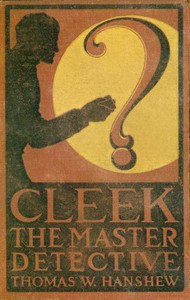
CLEEK, THE MASTER DETECTIVE
THE AFFAIR OF THE MAN WHO CALLED HIMSELF HAMILTON CLEEK
The thing wouldn't have happened if any other constable than Collins had been put on point duty at Blackfriars Bridge that morning. For Collins was young, good-looking, and knew it. Nature had gifted him with a susceptible heart and a fond eye for the beauties of femininity. So when he looked round and saw the woman threading her way through the maze of vehicles at "Dead Man's Corner," with her skirt held up just enough to show two twinkling little feet in French shoes, and over them a graceful, willowy figure, and over that an enchanting, if rather too highly tinted, face, with almond eyes and a fluff of shining hair under the screen of a big Parisian hat--that did for him on the spot.
He saw at a glance that she was French--exceedingly French--and he preferred English beauty, as a rule. But, French or English, beauty is beauty, and here undeniably was a perfect type, so he unhesitatingly sprang to her assistance and piloted her safely to the kerb, revelling in her voluble thanks and tingling as she clung timidly but rather firmly to him.
"Sair, I have to give you much gratitude," she said in a pretty, wistful sort of way, as they stepped on to the pavement. Then she dropped her hand from his sleeve, looked up at him, and shyly drooped her head, as if overcome with confusion and surprise at the youth and good looks of him. "Ah, it is nowhere in the world but Londres one finds these delicate attentions, these splendid sergeants de ville," she added, with a sort of sigh. "You are wonnerful, you are mos' wonnerful, you Anglais poliss. Sair, I am a stranger; I know not ze ways of this city of amazement, and if monsieur would so kindly direct me where to find the Abbey of the Ves'minster----"
Before P. C. Collins could tell her that if that were her destination, she was a good deal out of her latitude, indeed, even before she concluded what she was saying, over the rumble of the traffic there rose a thin, shrill, piping sound, which to ears trained to its call possessed a startling significance.
It was the shrilling of a police whistle far off down the Embankment.
"Hullo! That's a call to the man on point," exclaimed Collins, all alert at once. "Excuse me, mum. See you presently. Something's up. One of my mates is a-signalling me."
"Mates, monsieur? Mates? Signalling? I shall not unnerstand the vords. But yes, vat shall that mean--eh?"
"Good Lord, don't bother me now! I--I mean, wait a bit. That's the call to 'head off' some one, and---- By George! there he is now, coming head on, the hound, and running like the wind!"
For of a sudden, through a break in the traffic, a scudding figure had sprung into sight. It was the figure of a man in a gray frock-coat and a shining "topper," a well-groomed, well-set-up man, with a small, turned-up moustache and hair of a peculiar reddish shade. As he swung into sight, the distant whistle shrilled again; far off in the distance voices sent up cries of "Head him off!" "Stop that man!" etcetera; then those on the pavement near to the fugitive took up the cry, joined in pursuit, and in a twinkling, what with cabmen, tram-men, draymen, and pedestrians all shouting, there was hubbub enough for Hades.
From the opening pages, Cleek, the Master Detective establishes a detective who is as much a performer as a sleuth. The first case, 'The Affair of the Man Who Called Himself Hamilton Cleek,' introduces the title character through a theatrical reveal: a constable distracted by a 'French' woman in a Parisian hat, only to be outwitted. Cleek himself is a master of disguise, able to alter his appearance so completely that even his allies fail to recognize him. The stories are built around puzzles—a fifth pigeon in a cote, a locked steel room, a riddle of the ninth finger—that Cleek solves with a blend of observation and theatrical flair. Hanshew's prose is brisk, with a fondness for dramatic confrontations and clever misdirection. The collection, illustrated by Gordon Grant, offers a series of self-contained mysteries that reward attention to small details.
Clues in Plain Sight: The Pigeon and the Hempseed
In 'The Problem of the Red Crawl,' Cleek examines a lady's bedchamber and finds a hempseed, two grains of barley, and an oat on his palm. He immediately asks, 'Miss Morrison, do you keep pigeons?' The clue is mundane—birdseed—but it unlocks a chain of deductions about homing pigeons, a fifth bird in a cote, and a secret message system. Hanshew plants such details without fanfare, trusting the reader to notice. The pigeon clue is not a red herring; it is a literal thread leading to the solution. Similarly, in 'The Riddle of the Sacred Son,' a seemingly trivial object—a finger—becomes the key. These moments show Hanshew's method: the detective sees what others overlook, and the evidence is always present, though hidden in plain view.
The Detective as Chameleon: Disguise and Identity
Cleek's ability to change his appearance is central to his method. In the first chapter, he is introduced as a man who can 'pull their hair—rubbing their faces with a clean handkerchief' to remove any trace of makeup, suggesting he is not what he seems. The frontispiece caption—'Of a truth you are a charming fellow, monsieur.... What a pity you should be a police spy'—underscores the tension between his charming exterior and his role as a detective. Throughout the collection, Cleek adopts aliases (Mr. Headland, for instance) and alters his voice and manner. This fluid identity raises questions about the nature of the self: is Cleek a reformed criminal, a gentleman, or both? The stories do not resolve this ambiguity, but they exploit it for suspense.
Theatrical Confrontations and the Mechanics of Mystery
Hanshew favors dramatic set-pieces. In 'The Wizard's Belt,' Cleek swings a hammer to shatter a nymph statue 'with a force that shattered the monstrous thing to atoms.' In 'The Mystery of the Steel Room,' he strips down a counterpane and empties a water-jug over mattresses. These actions are not mere violence; they are the detective's method of revealing hidden mechanisms. The stories often hinge on physical tricks—a secret door, a false wall, a pigeon cote with a spring latch. Cleek's solutions are explained in a final scene where he reconstructs the crime for the assembled characters, like a magician revealing his trick. This structure gives each story a satisfying closure, though the explanations can feel rushed. The reader is invited to follow the clues, but the final reveal is always Cleek's performance.
These twelve stories reward readers who enjoy puzzles and period atmosphere. Pay attention to the small objects—a seed, a finger, a pigeon—as they often carry the solution. Hanshew's Cleek is a precursor to later gentleman detectives, but with a rougher edge and a love of disguise. The collection is best read as a series of intellectual games, each with a clever twist. Approach each case as Cleek does: look for what does not fit, and expect the unexpected.
Cleek’s disguises always felt like a gentle game—a man slipping into other skins to find the truth’s quiet core. I recall that same warmth in Hemlock Holmes, where logic wears a friend’s patient smile. Both detectives share a shadowed past, yet their cases breathe with a kindly, unhurried rhythm, like old clocks. The Adventures of the Eleven Cuff-Buttons Being one of the exciting episodes in the career of the famous detective Hemlock Holmes, as recorded by his friend Dr. Watson — Themes and Context rests beside them on my shelf, a familiar companion.
There are no reviews for this eBook.
There are no comments for this eBook.
Reader reflection
What was your reading experience?
Capture what you thought, learned, and would like to remember.
Your progress
0
/
10
2
How much did you enjoy the reading experience?
3
Is this a title you would suggest to others?
4
How easy was the book to follow?
5
How closely did the book connect with your experience?
6
How valuable was this book for your own interests?
7
What was the strongest part of the book?
8
Could you follow the author’s main argument?
9
In one sentence, what did you learn?
10