1

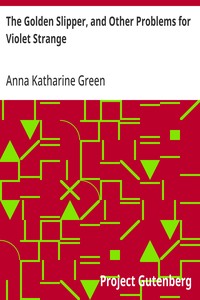
The Golden Slipper, and Other Problems for Violet Strange — A Reader’s Guide
(0 User reviews)
318
Project Gutenberg
2002
Not confirmed
Detective and mystery stories, American
Readers of public-domain and historical texts
Project Gutenberg digital edition
en
Edition facts
Words
95,853
Reading time
417 min
Text sections
10
The source record for The Golden Slipper, and Other Problems for Violet Strange — A Reader’s Guide measures this digital text at 95,853 words, 6 hr 57 min estimated reading time, and 10 detected text sections.
The text analysis averages about 18.7 words per sentence, while the detected sections provide another way to judge how the source is divided.
Project Gutenberg metadata also associates the work with “Detective and mystery stories, American,” connecting these edition facts with the source record’s subject description.
Source:
Project Gutenberg record #3071
In this collection of nine mysteries, debutante detective Violet Strange uses her social position to solve crimes among New York's elite, with each problem hinging on a distinctive object or setting—a golden slipper, a house of clocks, a missing page.
Editorial Edition Score
4.8/5
★★★★★
★★★★★
Calculated from edition completeness, EPUB availability, text structure and catalogue metadata. Not a user rating.
How this score is calculated
- Description quality20 pts
- Title & short description10 pts
- Source metadata20 pts
- Text length15 pts
- Chapters / structure15 pts
- EPUB file integrity20 pts
Total of 100 points, scaled to a 2.5-5.0 range. Editions with an empty description or a missing EPUB file are not scored.
Edition quality
Read the Text
the tier upon tier of boxes rising before his eyes, no other personality could vie with hers in strangeness, or in the illusive quality of her ever-changing expression. She was vivacity incarnate and, to the ordinary observer, light as thistledown in fibre and in feeling. But not to all. To those who watched her long, there came moments--say when the music rose to heights of greatness--when the mouth so given over to laughter took on curves of the rarest sensibility, and a woman’s lofty soul shone through her odd, bewildering features.
Driscoll had noted this, and consequently awaited her reply in secret hope.
It came in the form of a question and only after an instant’s display of displeasure or possibly of pure nervous irritability.
“Nothing. But slander is in the air, and any day it may ripen into public accusation.”
“Accusation of what?” Her tone was almost pettish.
“Of--of theft,” he murmured. “On a great scale,” he emphasized, as the music rose to a crash.
“Inestimable ones. They are always returned by somebody. People say, by me.”
“Ah!” The little lady’s hands grew steady,--they had been fluttering all over her lap. “I will see you to-morrow morning at my father’s house,” she presently observed; and turned her full attention to the stage.
Some three days after this Mr. Driscoll opened his house on the Hudson to notable guests. He had not desired the publicity of such an event, nor the opportunity it gave for an increase of the scandal secretly in circulation against his daughter. But the Ambassador and his wife were foreign and any evasion of the promised hospitality would be sure to be misunderstood; so the scheme was carried forward though with less eclat than possibly was expected.
Among the lesser guests, who were mostly young and well acquainted with the house and its hospitality, there was one unique figure,--that of the lively Miss Strange, who, if personally unknown to Miss Driscoll, was so gifted with the qualities which tell on an occasion of this kind, that the stately young hostess hailed her presence with very obvious gratitude.
The manner of their first meeting was singular, and of great interest to one of them at least. Miss Strange had come in an automobile and had been shown her room; but there was nobody to accompany her down-stairs afterward, and, finding herself alone in the great hall, she naturally moved toward the library, the door of which stood ajar. She had pushed this door half open before she noticed that the room was already occupied. As a consequence, she was made the unexpected observer of a beautiful picture of youth and love.
A young man and a young woman were standing together in the glow of a blazing wood-fire. No word was to be heard, but in their faces, eloquent with passion, there shone something so deep and true that the chance intruder hesitated on the threshold, eager to lay this picture away in her mind with the other lovely and tragic memories now fast accumulating there. Then she drew back, and readvancing with a less noiseless foot, came into the full presence of Captain Holliday drawn up in all the pride of his military rank beside Alicia, the accomplished daughter of the house, who, if under a shadow as many whispered, wore that shadow as some women wear a crown.
Miss Strange was struck with admiration, and turned upon them the brightest facet of her vivacious nature all the time she was saying to herself: “Does she know why I am here? Or does she look upon me only as an additional guest foisted upon her by a thoughtless parent?”
There was nothing in the manner of her cordial but composed young hostess to show, and Miss Strange, with but one thought in mind since she had caught the light of feeling on the two faces confronting her, took the first opportunity that offered of running over the facts given her by Mr. Driscoll, to see if any reconcilement were possible between them and an innocence in which she must henceforth believe.
They were certainly of a most damaging nature.
The first problem opens at the opera, where a gentleman is astonished to learn that the "silly little chit" Violet Strange is a secret agent. This contrast between her frivolous social persona and her sharp investigative mind sets the tone for the collection. Each story presents a self-contained puzzle, often revolving around a specific object—the golden slipper of the title, a second bullet, an intangible clue—that Violet must interpret.
The excerpts reveal a recurring structural pattern: Violet is introduced into a closed circle of suspects, usually wealthy families, and she solves the mystery through psychological insight and careful observation rather than physical evidence. The stories move between drawing rooms, opera boxes, and shadowy halls, with Violet often appearing unexpectedly to extract confessions.
The Opera Box as Crime Scene
The collection establishes a distinctive social geography. The first problem begins in a theater box, a semi-public space where Violet is both seen and unseen. The narrator notes that the Pratt family, "notably unsympathetic" in temperament, shower Violet with attention—a clue that she has already solved a problem for them. This opening scene is typical: Violet operates within high society, using her debutante status as cover. The opera box, the drawing room, and the country house are not just settings but active elements in the puzzles. They define who can be present, what can be overheard, and how secrets are kept. In "The House of Clocks," the corridors are described as "a mere hiding-place for clocks," and the old man's ritual of listening to each clock becomes the key to the mystery. The physical arrangement of space—the branching corridors, the solitary lamp, the tall clock door—is as important as any clue.
Recurring Images: Lamps, Clocks, and Shadows
Throughout the excerpts, certain images recur with thematic weight. Lamps flare up and sink down, as if responding to supernatural calls. In "The House of Clocks," the lamp in the lower hall "flared up as in a sudden gust, then sank down flickering and faint." This image of uncertain light mirrors the old man's wavering mind. Clocks are everywhere—not just timepieces but oracles. The old man listens to them as if they speak: "They say Yes! They are all saying Yes! now; but this one will say No!" The pendulum hangs motionless, yet he hears a verdict. Shadows and twilight dominate the interiors; corridors are "sunk in twilight shadows." Violet herself emerges from darkness, stepping forth from the clock's tall door. These images create a world where the boundary between the real and the imagined is porous, and where objects seem to hold hidden meanings.
Movement Between Scenes: The Detective's Entrance
Violet's method of entering a scene is carefully staged. In "The House of Clocks," she steps out of the clock itself, having hidden inside to observe the old man's ritual. This theatrical entrance is characteristic: she appears suddenly, often from a concealed position, and her arrival shifts the dynamic. In the first problem, she is already present in the opera box before the reader knows her role. The narrative moves from the public space of the theater to the private confession in a darkened drawing room. The old man, wandering "like a helpless child," is led by Violet's gentle hand. The movement is from confusion to clarity, from shadow to light. The stories often begin with a description of a scene—a dinner party, a country house—then narrow to a single room where the confrontation occurs. Violet's own movements are described with precision: she "crept rather than walked" or "stepped forth" from hiding. This choreography underscores her control over the investigation.
Confession as Structural Climax
Each problem builds toward a confession, often delivered in a monologue. The excerpts show the old man speaking "with the freedom of one to whom speech is life's last boon, and the ear of the listener quite forgotten." He confesses his unrequited love for Arabella, revealing his motive. This pattern—a character unburdening themselves in a darkened room—recurs across the stories. Violet's role is to create the conditions for confession: she listens, she prompts, she appears at the right moment. The confessions are not extracted through interrogation but through psychological pressure and empathy. The old man mistakes her for a phantom of his imagination; she allows him to speak. The climax is less about revealing a hidden clue than about the release of a long-held secret. This emphasis on confession over deduction gives the collection a psychological depth, focusing on the inner lives of suspects rather than on puzzle mechanics.
Readers will find that the pleasure of these stories lies not in guessing the culprit but in watching Violet navigate the social codes of her world. Pay attention to the objects that give each problem its title—they are never mere decoration. The golden slipper, the second bullet, the house of clocks: each is a key to the puzzle, but also a symbol of the hidden desires and fears that drive the characters. Violet Strange remains an enigma herself, and the collection offers only glimpses of her motives.
I remember sitting with The Golden Slipper on a gray afternoon, struck by how Violet’s quiet noticing of a satin heel could unravel a whole life’s pretense. That same hush came over me with The Filigree Ball Being a full and true account of the solution of the mystery concerning the Jeffrey-Moore affair — Background and Themes—both felt less like puzzles and more like listening to rooms hold their breath.
There are no reviews for this eBook.
There are no comments for this eBook.
Reader reflection
How will you remember this book?
Save your reaction, strongest insight, and memorable passage.
Your progress
0
/
10
2
How much did you enjoy the reading experience?
3
Would you pass this book on to a friend?
4
How easy was the book to follow?
5
Do you expect to return to this book?
6
How did the reading compare with what you expected?
7
How closely did the book connect with your experience?
8
How useful did the reading feel?
9
What is the main idea you are taking away?
10