1

The Bat — Edition Insights
(0 User reviews)
361
Project Gutenberg
2000
Not confirmed
Detective and mystery stories
Readers of public-domain and historical texts
Project Gutenberg digital edition
en
Edition facts
Words
67,894
Reading time
296 min
Text sections
23
The Bat — Edition Insights can be approached with a clearer sense of reading commitment from its source measurements: 67,894 words, 4 hr 56 min estimated reading time, and 23 detected text sections.
The text analysis averages about 12.6 words per sentence, while the detected sections provide another way to judge how the source is divided.
Project Gutenberg metadata also associates the work with “Detective and mystery stories,” connecting these edition facts with the source record’s subject description.
Source:
Project Gutenberg record #2019
An editorial note on the structure and recurring imagery in 'The Bat', a mystery by Mary Roberts Rinehart and Avery Hopwood, focusing on the movement between scenes and the use of the bat as a symbol.
Editorial Edition Score
4.8/5
★★★★★
★★★★★
Calculated from edition completeness, EPUB availability, text structure and catalogue metadata. Not a user rating.
How this score is calculated
- Description quality20 pts
- Title & short description10 pts
- Source metadata20 pts
- Text length15 pts
- Chapters / structure15 pts
- EPUB file integrity20 pts
Total of 100 points, scaled to a 2.5-5.0 range. Editions with an empty description or a missing EPUB file are not scored.
Edition quality
Read the Text
iting enough at moments, had never actually been dangerous and time was slipping away without giving her an opportunity to prove her hardiness of heart. Whenever she thought of this the fact annoyed her extremely—and she thought of it now.
She threw down the morning paper disgustedly. Here she was at 65—rich, safe, settled for the summer in a delightful country place with a good cook, excellent servants, beautiful gardens and grounds—everything as respectable and comfortable as—as a limousine! And out in the world people were murdering and robbing each other, floating over Niagara Falls in barrels, rescuing children from burning houses, taming tigers, going to Africa to hunt gorillas, doing all sorts of exciting things! She could not float over Niagara Falls in a barrel; Lizzie Allen, her faithful old maid, would never let her! She could not go to Africa to hunt gorillas; Sally Ogden, her sister, would never let her hear the last of it. She could not even, as she certainly would if she were a man, try and track down this terrible creature, the Bat!
She sniffed disgruntledly. Things came to her much too easily. Take this very house she was living in. Ten days ago she had decided on the spur of the moment—a decision suddenly crystallized by a weariness of charitable committees and the noise and heat of New York—to take a place in the country for the summer. It was late in the renting season—even the ordinary difficulties of finding a suitable spot would have added some spice to the quest—but this ideal place had practically fallen into her lap, with no trouble or search at all. Courtleigh Fleming, president of the Union Bank, who had built the house on a scale of comfortable magnificence—Courtleigh Fleming had died suddenly in the West when Miss Van Gorder was beginning her house hunting. The day after his death her agent had called her up. Richard Fleming, Courtleigh Fleming’s nephew and heir, was anxious to rent the Fleming house at once. If she made a quick decision it was hers for the summer, at a bargain. Miss Van Gorder had decided at once; she took an innocent pleasure in bargains. The next day the keys were hers—the servants engaged to stay on—within a week she had moved. All very pleasant and easy no doubt—adventure—pooh!
And yet she could not really say that her move to the country had brought her no adventures at all. There had been—things. Last night the lights had gone off unexpectedly and Billy, the Japanese butler and handy man, had said that he had seen a face at one of the kitchen windows—a face that vanished when he went to the window. Servants’ nonsense, probably, but the servants seemed unusually nervous for people who were used to the country. And Lizzie, of course, had sworn that she had seen a man trying to get up the stairs but Lizzie could grow hysterical over a creaking door. Still—it was queer! And what had that affable Doctor Wells said to her—“I respect your courage, Miss Van Gorder—moving out into the Bat’s home country, you know!” She picked up the paper again. There was a map of the scene of the Bat’s most recent exploits and, yes, three of his recent crimes had been within a twenty-mile radius of this very spot. She thought it over and gave a little shudder of pleasurable fear. Then she dismissed the thought with a shrug. No chance! She might live in a lonely house, two miles from the railroad station, all summer long—and the Bat would never disturb her. Nothing ever did.
She had skimmed through the paper hurriedly; now a headline caught her eye. _Failure of Union Bank_—wasn’t that the bank of which Courtleigh Fleming had been president? She settled down to read the article but it was disappointingly brief. The Union Bank had closed its doors; the cashier, a young man named Bailey, was apparently under suspicion; the article mentioned Courtleigh Fleming’s recent and tragic death in the best vein of newspaperese. She laid down the paper and thought—_Bailey—Bailey_—she seemed to have a vague recollection of hearing about a young man named Bailey who worked in a bank—but she could not remember where or by whom his name had been mentioned.
Well—it didn’t matter. She had other things to think about. She must ring for Lizzie—get up and dress. The bright morning sun, streaming in through the long window, made lying in bed an old woman’s luxury and she refused to be an old woman.
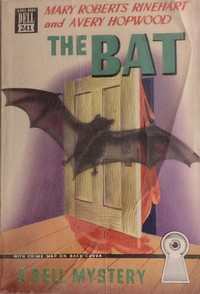
The Bat opens with a triple demand—'Get him—get him—get him!'—echoing from a police chief, a millionaire, and a young detective. This refrain establishes the central antagonist as a phantom, a 'specter down the alleyways of the wind.' The narrative structure relies on rapid scene shifts between these frustrated authority figures and the domestic setting of Miss Cornelia Van Gorder's country house, where the action soon concentrates. The bat itself appears not as a literal creature but as a signature left at crime scenes, a recurring image that ties the scattered locations together.
The Refrain of Pursuit
The opening chapter uses a repeated command—'Get him'—to create a sense of obsessive chase. This phrase appears in three distinct contexts: a police chief's ultimatum to his detectives, a millionaire's plea to a private investigator, and a young agent's boast. Each iteration escalates the stakes, but the quarry remains unnamed, referred to only as 'the master criminal of a century.' The repetition mimics the rhythm of a manhunt, with the word 'him' becoming a placeholder for an unknown threat. Later, the same verbal pattern recurs in the interrogation scenes, where Detective Anderson drills suspects with pointed questions, mirroring the earlier urgency. This structural echo links the external manhunt to the internal pressure within the house.
The Bat as a Signature
The bat symbol functions as a recurring visual marker rather than a literal animal. In the excerpts, it appears in chapter titles—'The Shadow of the Bat,' 'The Sign of the Bat'—and is referenced as a calling card left at crime scenes. The narrative never describes the bat in flight; instead, it is a printed or drawn emblem, a 'sign' that signals the criminal's presence. This abstraction allows the bat to represent both the criminal's identity and the fear he inspires. The image of a 'shadow' or 'sign' suggests something glimpsed rather than confronted, aligning with the story's reliance on unseen threats and hidden rooms. The bat thus becomes a structural device, marking moments of revelation or danger.
Movement Between Confined Spaces
The action shifts rapidly between the claustrophobic interiors of the country house and the brief, vivid exteriors of police offices and city streets. The opening scenes in the police chief's office and the detective agency are cramped, filled with frustrated gestures—'pounding a heavy fist,' 'threw up his hands.' In contrast, the house scenes emphasize doors, ash trays, and fireplaces, objects that become clues. The movement between these spaces is abrupt, often signaled by a new chapter heading like 'The Storm Gathers' or 'A Shot in the Dark.' This jump-cut structure keeps the reader disoriented, mirroring the characters' uncertainty. The house itself becomes a maze of rooms and hidden passages, with characters constantly entering and exiting, searching for something or someone.
Objects as Triggers
Small physical objects drive the plot forward and create suspense. In the excerpts, a half-burned cigarette with a monogram, a fragment of blue-print, and a blackened bag each serve as evidence that shifts suspicion. The cigarette is discovered on an ash tray, leading Anderson to deduce Fleming's presence; the blue-print fragment is retrieved from the fireplace, linking Dale to the crime. These objects are handled with deliberate care—'displaying,' 'rummaged,' 'fluttering between his fingers'—and their discovery often interrupts dialogue, changing the direction of questioning. The narrative treats these items as almost animate, with the power to incriminate or exonerate. This focus on tangible clues grounds the mystery in physical reality, even as the bat remains an elusive symbol.
The Bat relies on a structure of pursuit and confinement, where the chase is both external and internal. Readers should pay attention to the placement of objects and the movement between rooms, as these details often signal shifts in the investigation. The bat itself is less a creature than a mark, a reminder that the criminal is never fully seen. This orientation toward the unseen and the hidden makes the story a study in suspense through absence.
Reading the editorial note about The Bat, with its careful movement between rooms and that flutter of shadow on the wall, I found myself thinking of another old house, another creaking stair. That Mainwaring Affair — Context and Discussion shares that same quiet patience with dark corners. Both feel like evenings spent waiting for a footstep you half expect, half hope to hear.
There are no reviews for this eBook.
There are no comments for this eBook.
Reader reflection
Record your reading impressions
A brief reflection can help important ideas stay with you longer.
Your progress
0
/
10
2
What was your overall reaction to the book?
3
Is this a title you would suggest to others?
4
What was the reading difficulty like?
5
Did the book deliver what you hoped for?
6
How personally connected did you feel to the book?
7
Could you apply anything you learned?
8
How much did the book move you?
9
What changed or sharpened your thinking?
10