
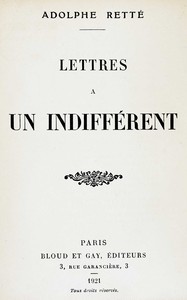
Lettres à un indifférent by Adolphe Retté
Adolphe Retté's Lettres à un indifférent is a strange and powerful little book. It's not a novel with a plot in the usual sense. Instead, it's a collection of letters written to an unnamed friend, a stand-in for the apathy Retté saw taking over the world—and maybe his own heart.
The Story
The book follows Retté's internal journey after a period of deep disillusionment. He'd been part of the avant-garde Symbolist movement and then a passionate anarchist. But by the time he writes these letters, those identities have lost their shine. He feels like a spectator in his own life, watching everything with cold detachment. Each letter is a attempt to break through that numbness. He argues with his 'indifferent' friend about art, society, nature, and God. He describes walks in the forest, critiques modern life, and grapples with the idea of faith. The 'story' is the slow, painful, and sometimes beautiful process of a man trying to feel something real again.
Why You Should Read It
What hooked me was the sheer honesty. This isn't a polished philosophical treatise. It's messy, emotional, and deeply personal. Retté doesn't have the answers, and he doesn't pretend to. He's just asking the questions out loud, with a urgency that jumps off the page. When he writes about the silence of the woods or the emptiness of city life, you feel his struggle to connect. It's a book about a very specific historical moment, but the core feeling—that sense of being lost and searching for solid ground—is timeless. It reminds you that existential crises aren't a modern invention.
Final Verdict
This book is perfect for readers who love personal, introspective writing and aren't afraid of a text that asks more questions than it answers. Think of it as a historical companion for anyone who's ever had a 'what's it all for?' moment. If you enjoy the confessional style of writers like Montaigne or the spiritual searching in Thomas Merton's work, you'll find a kindred spirit in Retté. It's not a light read, but it's a short and surprisingly gripping one. You come away feeling like you've had a long, intense, and ultimately rewarding conversation with a complicated, brilliant mind from another century.
This work has been identified as being free of known copyright restrictions. It is available for public use and education.
Richard Jones
9 months agoAs someone working in this industry, I found the insights very accurate.
Thomas Brown
6 months agoThe layout of the digital version made it easy to start immediately, the insights into future trends are particularly thought-provoking. It’s hard to find this much value in a single source these days.
Patricia Gonzalez
1 year agoGiven the current trends in this field, the data points used to support the main thesis are quite robust. Definitely a five-star contribution to the field.
Kimberly Martin
1 year agoAs a long-time follower of this subject matter, the way it handles controversial points with balance is quite professional. This exceeded my expectations in almost every way.
Karen Perez
3 weeks agoBefore I started my latest project, I read this and it manages to maintain a consistent flow even when discussing difficult topics. The insights gained here are worth every minute of reading.