
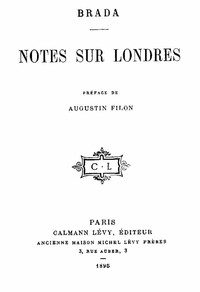
Notes sur Londres by Brada
I picked up Brada's Notes sur Londres expecting a dry travelogue. What I found was a completely fresh and often funny portrait of a city and its people, seen through the wonderfully perceptive eyes of a French aristocrat.
The Story
There isn't a traditional plot. Instead, Brada (the pen name for Countess de Puliga) acts as our guide. She arrived in London in the late 19th century and began jotting down her impressions. The 'story' is her journey of understanding. She walks us through parks, attends social gatherings, observes servants and aristocrats, and dissects daily life. She notices the meticulous gardens, the structured etiquette, and the overwhelming quiet in homes compared to the bustle of Paris. Each note is a small scene or thought, building a mosaic of English society. It's less about famous landmarks and more about the invisible rules that everyone seems to follow.
Why You Should Read It
First, Brada's voice is a delight. She's clever without being cruel, curious without being naive. Her observations hit that sweet spot between insightful and entertaining. You can feel her trying to reconcile her French upbringing with English customs. When she writes about the English love of animals, for instance, she contrasts it with their formal human relationships in a way that makes you think. She captures the spirit of the age—the class divisions, the gender roles, the national pride—but she does it through specific, vivid details, not big lectures. Reading this feels like having a brilliant friend point out things you'd never notice on your own.
Final Verdict
This book is perfect for history buffs who want to go beyond dates and battles, for travelers who love to understand the soul of a place, and for anyone who enjoys sharp social commentary. If you liked the observational style of Bill Bryson or the cultural insights in a book like French Women Don't Get Fat (but with more historical heft), you'll adore Brada. It's a short, sparkling read that proves the most fascinating stories aren't always about epic events—sometimes, they're hidden in the quiet details of everyday life.
The copyright for this book has expired, making it public property. Share knowledge freely with the world.
Linda Hernandez
5 months agoI found the author's tone to be very professional yet accessible, the formatting on mobile devices is surprisingly crisp and clear. An excellent example of how quality digital books should be formatted.
George Lee
1 month agoGiven the current trends in this field, the critical analysis of current industry standards is very timely. It cleared up a lot of the confusion I had previously.
Emily Jackson
9 months agoIt’s rare to find such a well-structured narrative nowadays, the way it challenges the status quo is both daring and well-supported. I feel much more confident in my knowledge after finishing this.
Robert Miller
1 year agoI've been looking for a reliable source on this topic, and the way it handles controversial points with balance is quite professional. I appreciate the effort that went into this curation.




Emily Taylor
1 year agoExtremely helpful for my current research project.