
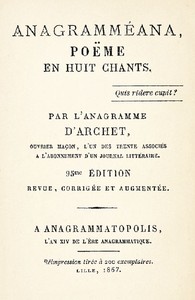
Anagramméana, poëme en huit chants by G. A. J. Hécart
Let's be clear from the start: This is not a normal book. Published in 1821 by Gabriel Antoine Joseph Hécart, a librarian from Valenciennes, Anagramméana, poëme en huit chants is a bizarre and fascinating artifact. On the surface, it presents itself as a long, humorous poem in eight cantos ('chants'). But that's just the delivery method for Hécart's true project: an obsessive, playful, and subversive experiment with language.
The Story
Formally, the poem follows a satirical and mock-heroic journey, poking fun at the society and literary trends of Hécart's time. But the plot is almost secondary. The real 'story' unfolds in the layers of wordplay. Hécart fills every line with anagrams—rearranging letters of names and phrases to create hidden meanings, often barbed with criticism or inside jokes. He uses acrostics (where the first letters of lines spell a message) and other linguistic tricks to embed a secret commentary within the published text. Reading it straight through gives you one experience; deciphering it gives you a completely different, and arguably the intended, one.
Why You Should Read It
I love this book because it feels like a conversation with a mischievous, hyper-literate mind from the past. Hécart wasn't just showing off. In an age of strict censorship, wordplay was a tool for satire and safe criticism. Unraveling his puzzles feels like uncovering gossip and grievances from 1820s France. It’s a hands-on history lesson. More than that, it’s a celebration of language's flexibility and a reminder that reading can be an active, detective-like pursuit. You're not passively receiving a story; you're collaborating with the author to find it.
Final Verdict
This book is a niche masterpiece. It's perfect for puzzle lovers, logophiles, and historians of quirky literature. If you enjoy crosswords, cryptic clues, or books like Ella Minnow Pea, you'll appreciate Hécart's genius. It's also great for anyone interested in the history of satire and coded communication. However, if you want a fast-paced plot or deep character development, you'll be frustrated. Approach this as a literary game, not a novel. Think of it as a museum exhibit you're allowed to touch and solve. It’s a unique, brain-tickling experience you won't find anywhere else.
This book is widely considered to be in the public domain. Preserving history for future generations.
David Smith
4 months agoFrom a researcher's perspective, the critical analysis of current industry standards is very timely. Highly recommended for those seeking credible information.
Donald Martin
2 months agoI was particularly interested in the case studies mentioned here, the structural organization allows for quick referencing of key points. An excellent example of how quality digital books should be formatted.
Susan White
8 months agoThe author provides a very nuanced critique of current methodologies.
Donald Hernandez
9 months agoOne of the most comprehensive guides I've read this year.

Patricia Jones
1 year agoThe balance between academic rigor and readability is perfect.