1

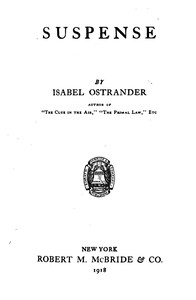
Suspense — Edition Insights
(0 User reviews)
1919
Project Gutenberg
2025
Not confirmed
Detective and mystery stories; Young women -- Fiction; Paid companions (Household employees) -- Fiction
Readers of public-domain and historical texts
Project Gutenberg digital edition
en
Edition facts
Words
81,438
Reading time
355 min
Text sections
21
For Suspense — Edition Insights, the stored edition analysis reports 81,438 words, 5 hr 55 min estimated reading time, and 21 detected text sections.
The text analysis averages about 16.6 words per sentence, while the detected sections provide another way to judge how the source is divided.
Project Gutenberg metadata also associates the work with “Detective and mystery stories,” connecting these edition facts with the source record’s subject description.
Source:
Project Gutenberg record #75240
Isabel Ostrander's 1918 mystery uses clipped dialogue, theatrical gestures, and a scarred heroine to build tension. The opening advertisement and the limousine's 'sinister' arrival establish a world where every glance and whisper may conceal betrayal.
Editorial Edition Score
4.9/5
★★★★★
★★★★★
Calculated from edition completeness, EPUB availability, text structure and catalogue metadata. Not a user rating.
How this score is calculated
- Description quality20 pts
- Title & short description10 pts
- Source metadata20 pts
- Text length15 pts
- Chapters / structure15 pts
- EPUB file integrity20 pts
Total of 100 points, scaled to a 2.5-5.0 range. Editions with an empty description or a missing EPUB file are not scored.
Edition quality
Read the Text
here was a smothered exclamation at the other end of the wire, and Mrs. Atterbury snatched the receiver from the girl's hand.
"What is it?" she demanded in a voice which she strove in vain to control.
"I-I don't know," Betty murmured. "The person spoke so quickly I could not distinguish a word." "Mrs. Atterbury speaking.... Oh, the market has broken? Well, sell the shares I hold in that company at whatever price you can obtain, do you understand? At whatever price! There will be no panic, tell your partner not to lose his head. It must be made clear that I will trade no more in that stock.... It will be enough, it must be. Remember, I look to you to settle the matter absolutely. Let me have an accounting by tonight."
She hung up the receiver and turned with a shrug but Betty saw that her lips were white.
"My broker," she remarked, with studied carelessness. "Conscientious man, but not resourceful. By the way, my dear, I neglected to tell you that you need never answer this telephone. It is my own private wire. Call me if it rings when I am at home, but pay no attention to it if I am not here."
"I am sorry--" began Betty, but the other silenced her.
"It is of no consequence. We will take up the letters now. You did not find them difficult?"
"No-o," Betty responded hesitatingly. "There is one, however, which I could not understand at all. It seems to be a business matter, but the wording doesn't make any sense; it's something about sheep."
"Sheep?" Mrs. Atterbury's level tones sharpened. "Where is the envelope? Was there no cross upon it?"
"No. At least I didn't see any, and I am quite sure I looked carefully. This is the one."
"Idiot!" The ejaculation was clearly not intended for the girl, as Mrs. Atterbury looked vainly for the distinguishing mark, and filliped the envelope angrily aside. "Give me the letter, please."
She glanced over it rapidly, without comment or change of expression and put it on the little heap of private letters.
"We will get rid of the social ones first--" she was beginning, when Betty suddenly interrupted her.
"There is a motor car coming up the drive."
"Ah, it is Mme. Cimmino." Mrs. Atterbury arose, her glance following the trim little electric brougham as it lurched over the hillocks of snow. "She will probably stay to lunch, and that means the letters will have to be held over until tomorrow. Amuse yourself as well as you can, my dear. You'll find plenty of books here and there is a phonograph in the corner."
But Betty did not turn to the well-filled bookcases which lined the walls. Instead she sat with the strange letter spread out before her, reading and re-reading it as if to memorize every word. That it was a code of some sort she did not doubt, and without the key it would seem a hopeless task to attempt to decipher it, yet the young girl pored over it as eagerly as though its possible solution contained a message of vital import to herself as well as her employer.
Welch brought her lunch upon a tray and the afternoon was well advanced before the summons came for her to go to the sewing room. She spent the intervening hours in a searching examination of the library itself, but it yielded nothing of seeming interest or import to her. There was no sign of Mme. Cimmino, but her car had not left the drive and a subdued murmur as of several voices came from behind the tightly-closed door of the drawing-room as the girl passed. Welch ushered her to a large sunny room at the top of the house where she found Mrs. Atterbury deep in consultation with a faded little woman of indeterminate age who fluttered nervously on being presented.
"Miss Pope knows what you require, I think," observed Mrs. Atterbury. "Everything must be as simple as possible, you know."
Miss Pope nodded, her mouth full of pins which she was sticking with mathematical precision into the little flat cushion that hung from her belt. When the last was in place, she took up her tape measure.
"Now, miss, if you please."
Betty stood patiently, marvelling at the odd tremulousness of the withered hands which fumbled about her. Could it be merely nerves, or was the worn, pallid, little creature under the spell of some emotion too strong to be wholly controlled?
The novel opens not with a crime but with a classified advertisement: a young woman, 'stranger in city, without relatives,' seeks work as a companion. This small block of text, reprinted verbatim, serves as both plot device and character introduction. The heroine, Betty Shaw, is defined from the first by her calculated self-presentation—she writes her own script before the story begins.
Ostrander's prose leans heavily on physical cues: Betty's 'lifted chin,' 'quickened breath,' and the way her face becomes 'a mere mask of malevolent fury' when she spots a limousine. The car's 'rakish torpedo-shaped hood' and 'broad diagonal lines of white striping' are described with the precision of a police report, hinting at a world where objects carry menace. The author trusts readers to read surfaces for hidden meanings.
Diction as Disguise
Betty Shaw's speech shifts register with alarming speed. To the landlady she is 'guilelessly soft and low'; to her employer, she delivers a fabricated story with 'wide ingenuous eyes.' When cornered by Mr. Wolvert, she falls into a 'whimper' and a childish excuse: 'I came down for a book I left unfinished.' Ostrander marks each performance with a tell—a tremor, a pause, a calculated stumble.
Wolvert's language is equally theatrical. He growls 'That doesn't go; it's too thin!' and uses criminal slang ('What's the lay?'). His hot breath 'laden with the fumes of wine' and his 'viselike grip' are rendered in sensory detail that makes the threat physical. The dialogue never explains motive; it only reveals power plays in real time.
The author withholds interior monologue. We see Betty's 'alert brain out-pace her flying feet' but never hear her thoughts directly. This restraint forces the reader to infer intent from action and word choice alone.
The Vocabulary of Suspense
Ostrander builds tension through a narrow but potent lexicon. Words like 'sinister,' 'menace,' 'peril,' and 'suspense' recur, but they are anchored to concrete objects: a limousine, a torch, a safe. The 'throbbing purr of a motor' and 'dull grinding of brakes' are auditory cues that signal danger before any character speaks.
Physical reactions are catalogued with clinical precision. Betty's 'hands clenched, her breast heaving tumultuously'; Wolvert's 'agility of a cat'; Mrs. Atterbury's 'waxen expressionless face' with eyes like 'banked fires.' These descriptions do not merely decorate—they function as clues. A reader trained to notice the 'mask of malevolent fury' on Betty's face will question every subsequent display of innocence.
The author also uses silence as a device. When Betty knocks on Mrs. Atterbury's door, the response is 'a murmur' followed by a light flaring up. The pause between knock and answer is filled with unspoken calculation.
Setting as Psychological Mirror
The boarding house parlor is 'shrouded in gloom,' with 'shabbily ornate' furniture and 'whirling snowflakes' outside. This is not mere atmosphere; it reflects Betty's isolation and her precarious social position. The 'dingy curtains' and 'frowsy head' of the servant Susan ground the story in a specific, unglamorous poverty.
Contrast arrives with the limousine: 'massive,' 'blackly looming,' with a 'rakish torpedo-shaped hood.' The car is described as a 'veritable juggernaut,' a word that evokes both wealth and destruction. Ostrander uses setting to externalize class anxiety. The wealthy characters inhabit spaces of controlled luxury—Mrs. Atterbury's white robe and 'pink boudoir candle' suggest a feminized, fragile opulence.
The library, where the confrontation occurs, is dark and filled with 'papers all scattered about.' The open safe becomes a stage prop. Ostrander never describes the room's dimensions or furniture; she focuses only on what the characters touch and see in moments of crisis.
Voice and the Unreliable Narrator
Though told in third person, the narrative clings to Betty's perspective. We see only what she sees, and her interpretations are often contradicted by her own actions. When she 'recoiled from the window' at the sight of the limousine, the narrative calls her face 'distorted into a mere mask of malevolent fury akin to triumph.' The word 'triumph' suggests a hidden agenda, but the text offers no confirmation.
Betty's lies to Mrs. Atterbury are presented without authorial comment. We hear her 'whisper' the story of the open safe, and we watch Mrs. Atterbury's 'keen analysis' weigh the fabrication. The reader is left to judge credibility without a narrator's nudge. This technique creates a constant, low-level uncertainty: every statement might be a performance.
Ostrander also uses free indirect discourse to blur the line between narrator and character. Phrases like 'Freedom, perhaps life itself, hung upon the issue' could be Betty's thought or the narrator's summary. The ambiguity forces the reader to remain alert, parsing each sentence for bias.
Ostrander's method rewards attentive reading. The scar mentioned in the chapter title never appears in the excerpt—a deliberate withholding that primes the reader for delayed reveals. Pay close attention to what characters do with their hands, how they modulate their voices, and what objects they choose to notice. In this novel, the smallest gesture may be a clue, and the most innocent phrase a trap.
Reading Suspense’s scarred heroine and that quiet dread in every glance, I found myself drifting to another old favorite, The Avalanche: A Mystery Story — Story, Setting & Ideas. Both feel like remembered rooms where shadows breathe, where trust is a fragile, borrowed thing. Something about that era’s watchful silences lingers, doesn’t it? A shared, whispered kinship between them.
There are no reviews for this eBook.
There are no comments for this eBook.
Reader reflection
How did this book work for you?
Your answers remain private and are stored only in this browser.
Your progress
0
/
10
2
How did the book work for you overall?
3
Would you recommend this book to another reader?
4
What was the reading difficulty like?
5
Is this a title worth rereading?
6
How personally connected did you feel to the book?
7
Which aspect of the book did you value most?
8
How useful were the ideas in this book?
9
What is the main idea you are taking away?
10