
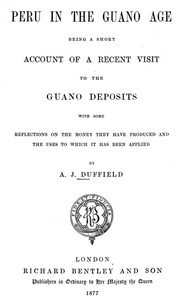
Peru in the Guano Age by A. J. Duffield
Let's get straight to it: Peru in the Guano Age is a first-hand account of one of history's most bizarre economic booms and busts. Written by A.J. Duffield, a British observer living in Peru in the late 1800s, this isn't a dry history textbook. It's a passionate, often angry, report from the ground.
The Story
For decades, Peru held a global monopoly on guano—the nitrogen-rich droppings of seabirds piled high on its coastal islands. This 'white gold' was in desperate demand to feed Europe's farms. Money flooded into the country. But instead of building a stable future, Peru's leaders and a swarm of foreign financiers concocted a series of disastrous loans, using the future guano sales as collateral. Duffield details how these deals, signed in London and Paris, saddled Peru with impossible debt. The guano wealth was shipped out before it was even dug up, funding lavish lifestyles for a few and leaving the country with nothing but IOUs. By the time the guano ran out, Peru was financially ruined, setting the stage for a devastating war.
Why You Should Read It
What grabbed me was Duffield's voice. He's not a neutral academic; he's a witness who is genuinely outraged by the corruption and short-sightedness he sees. He names names and spells out the shady contracts, making complex financial schemes understandable. You feel his frustration as he watches a nation's potential being squandered. The book transcends its specific time period. At its heart, it's a timeless case study in the 'resource curse'—the paradox where countries blessed with valuable natural resources often end up poorer and more unstable. Reading about the guano frenzy, you can't help but see echoes in oil booms, diamond mines, and other modern examples where quick wealth leads to long-term trouble.
Final Verdict
This is a perfect pick for readers who love narrative nonfiction that exposes the gritty mechanics of power and money. If you enjoyed books like Killers of the Flower Moon or The Devil in the White City for their deep dives into a specific historical moment, you'll appreciate Duffield's focused intensity. It's also great for anyone interested in Latin American history, economic history, or just a brilliantly told, cautionary true story. Be prepared: it might make you a little mad about something that happened 150 years ago. The best history books always do.
Legal analysis indicates this work is in the public domain. Use this text in your own projects freely.
Barbara Wilson
4 months agoUnlike many other resources I've purchased before, the author clearly has a deep mastery of the subject matter. An excellent example of how quality digital books should be formatted.
Joseph Gonzalez
7 months agoIt’s rare to find such a well-structured narrative nowadays, the way it handles controversial points with balance is quite professional. A rare gem in a sea of mediocre content.
Kevin Flores
2 years agoAs someone who reads a lot, it manages to explain difficult concepts in plain English. This story will stay with me.
George Perez
8 months agoI came across this while browsing and the pacing is just right, keeping you engaged. Truly inspiring.



George Jones
4 months agoIt took me a while to process the complex ideas here, but the emphasis on ethics and sustainability within the topic is commendable. It definitely lives up to the reputation of the publisher.