
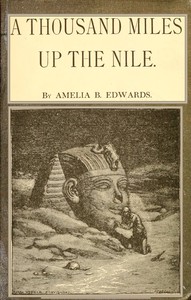
A thousand miles up the Nile by Amelia B. Edwards
In 1873, Amelia B. Edwards, a successful English novelist, decided to escape a wet British winter by sailing up the Nile River. With a couple of friends, she hired a dahabeeyah (a traditional sailing houseboat) named the Philae and a crew of local sailors. This book is the detailed, personal diary of that seven-month journey from Cairo to Abu Simbel and back.
The Story
There's no traditional plot, just the unfolding journey. We travel with her, stopping at every major monument along the way: the Pyramids of Giza, the temples of Luxor and Karnak, the Valley of the Kings. She describes climbing inside tombs, taking meticulous measurements of hieroglyphs, and camping in the shadow of ancient ruins. But the real story is in the travel itself. We feel the frustration when the wind dies and the boat is stuck for days. We laugh at her descriptions of chaotic market days and her struggles with a stubborn donkey named Yussuf. We see the Nile not as a backdrop, but as the central character—its moods, its people, and its timeless landscape.
Why You Should Read It
I loved this book because Amelia feels like a friend. She’s not a distant, perfect explorer. She gets tired, she complains about the food, and she’s openly emotional about what she sees. Her passion for preserving Egypt’s history is fierce and modern. Long before it was common, she was calling out the damage from careless tourists and looters. Her writing makes you feel the grit of the sand and the cool air inside a tomb. You’re right there with her, feeling that mix of exhaustion and absolute wonder. It’s this personal, boots-on-the-ground perspective that makes history come alive in a way no textbook ever could.
Final Verdict
Perfect for history buffs who want a human story, armchair travelers dreaming of adventure, and anyone who enjoys a sharp, observant voice from the past. If you liked the personal journey in Travels with a Donkey or the detailed observation in Bill Bryson’s books, but set in the 19th century, you’ll fall into this one. It’s a long, immersive read—not a quick thriller—but for the right reader, it’s an unforgettable trip.
Legal analysis indicates this work is in the public domain. You are welcome to share this with anyone.
James Thomas
2 months agoIt effectively synthesizes complex ideas into a coherent whole.
Jessica Thomas
2 years agoThe clarity of the introduction set high expectations, and the objective evaluation of the pros and cons is very refreshing. If you want to master this topic, start right here.
Elizabeth Rodriguez
1 year agoRight from the opening paragraph, the bibliography and references suggest a high level of research and authority. I'm glad I chose this over the other alternatives.
Margaret Wilson
8 months agoMy first impression was quite positive because the language used is precise without being overly academic or confusing. I'm glad I chose this over the other alternatives.


Barbara Harris
2 years agoGiven the current trends in this field, the practical checklists included are a great touch for real-world use. Top-tier content that deserves more recognition.