
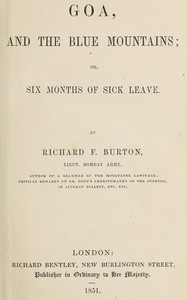
Goa and the Blue Mountains; or, Six months of sick leave by Burton
Picture this: It's 1847, and a young British army officer in India is ordered to take six months off to recover from illness. For most people, that means rest. For Sir Richard Francis Burton, it's an invitation. This book is the record of where that invitation led: first to the faded Portuguese colony of Goa on the coast, and then on a daring, difficult journey into the rugged hill ranges of southern India, then known as the Blue Mountains.
The Story
There's no traditional plot here. Instead, Burton acts as our fiercely intelligent and often critical tour guide. He starts in Goa, describing its crumbling churches and mixed heritage with a keen eye. But he's soon drawn inland, lured by the mountains on the horizon. What follows is a tough expedition. He travels with local guides, navigating dense forests, dealing with unreliable transport, and observing villages and tribes. He writes about everything he sees—from religious rituals and local politics to the practicalities of finding food and shelter. The "story" is the journey itself: the physical struggle, the cultural discoveries, and Burton's constant, analytical commentary on it all.
Why You Should Read It
You read this for Burton's voice. He's not a warm, fuzzy travel writer. He's sharp, sarcastic, deeply curious, and sometimes prejudiced by his time. That makes him fascinating. You're not getting a polished, romantic view of India; you're getting the raw, immediate impressions of a phenomenal linguist and explorer. His descriptions are vivid. You can feel the humidity of the jungle and the chill of the mountain air. More than a geography lesson, it's a snapshot of a world in transition and a portrait of a restless mind turning forced inactivity into a legendary adventure.
Final Verdict
Perfect for readers who love real exploration stories and don't mind a narrator who's a bit of a grumpy genius. If you enjoyed Patrick Leigh Fermor's wanderings or the curious spirit of books like The Songlines, you'll find a kindred spirit in Burton. It's also great for anyone interested in 19th-century India beyond the standard British colonial narrative. A word of caution: his views are very much of his era. Read it for the incredible firsthand account and the force of his personality, but keep a modern perspective handy.
This masterpiece is free from copyright limitations. Enjoy reading and sharing without restrictions.
Ashley Anderson
11 months agoThe balance between academic rigor and readability is perfect.
Robert Taylor
6 months agoI stumbled upon this title during my weekend research and the cross-referencing of different chapters makes it a great study tool. It’s hard to find this much value in a single source these days.
Jennifer Johnson
6 months agoRight from the opening paragraph, the clarity of the writing makes even the most dense sections readable. A rare gem in a sea of mediocre content.
Robert Harris
1 year agoUnlike many other resources I've purchased before, the concise summaries at the end of each section are a lifesaver. I'll be citing this in my upcoming project.







Robert Martinez
1 year agoI started reading this with a critical mind, the author manages to bridge the gap between theory and practice effectively. I am looking forward to the author's next publication.