
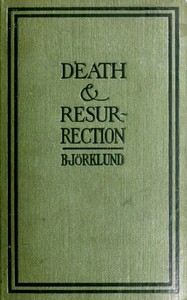
Death and resurrection from the point of view of the cell-theory by Björklund
Published in 1889, Gustaf Björklund's book is a fascinating collision of ideas. It arrived at a time when the cell theory—the discovery that all living organisms are composed of cells—was revolutionizing biology. Björklund seizes this new scientific framework and runs with it, straight into the territory of philosophy and metaphysics.
The Story
There isn't a plot in the traditional sense. Instead, think of it as a structured argument or a long, compelling essay. Björklund starts by laying out the basics of cell theory: how cells divide, how they form complex organisms, and how they eventually break down in what we call death. Then, he poses his central question. If the body is a collective of individual living cells, and if those cells have their own life cycles of birth and reproduction, what does that mean for the concept of a singular, final death for the person? He explores the idea that life, at its most fundamental level, is a continuous process of transformation and renewal. Death, from the cell's perspective, might just be a reorganization. He doesn't claim to have proof of an afterlife, but he uses science to pry open the door to possibilities that pure materialism had tried to slam shut.
Why You Should Read It
What grabbed me was the sheer audacity of the thought experiment. Björklund isn't trying to disprove science; he's using its own tools to ask questions science alone can't answer. Reading it, you feel the excitement of the 19th-century intellectual frontier. His writing, while dense, has a poetic quality when he describes the 'life-force' within cells. It makes you look at your own hand and wonder about the bustling, microscopic world inside it, and what its ultimate fate might be. It's less about finding definitive answers and more about appreciating the profound mystery that remains, even under the microscope.
Final Verdict
This is a niche read, but a rewarding one. It's perfect for readers who love the history of ideas, especially where science and philosophy meet. If you enjoyed books like 'The Immortal Life of Henrietta Lacks' for its ethical questions about cells, or if you like thought-provoking, older scientific texts, you'll find a kindred spirit in Björklund. Be warned: it's not a light beach read. It requires some focus, but it's short. You'll come away with a renewed sense of wonder about the very fabric of life, and you'll probably never think about death in quite the same way again.
No rights are reserved for this publication. Enjoy reading and sharing without restrictions.
Daniel Wilson
10 months agoI had low expectations initially, however the content flows smoothly from one chapter to the next. Truly inspiring.




Barbara Garcia
2 months agoI found the author's tone to be very professional yet accessible, the author’s unique perspective adds a fresh layer to the discussion. A solid investment for anyone's personal development.