
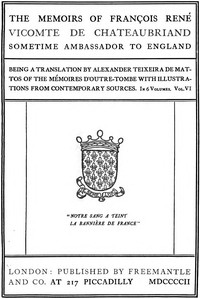
The Memoirs of François René Vicomte de Chateaubriand sometime Ambassador to…
François-René de Chateaubriand's Memoirs are less a straightforward story and more a magnificent, sprawling reflection on a life lived at the center of a historical earthquake. He doesn't just tell you what happened; he makes you feel the vertigo of it all.
The Story
Born into a noble family in Brittany, Chateaubriand's youth was one of privilege, but that world was about to shatter. He witnessed the French Revolution firsthand, a chaos that both horrified and fascinated him. For his own safety, he fled to America, where he wandered the wilderness—an experience that would fuel his romantic writing later. Returning to Europe, he joined the royalist army fighting against the Revolution, was wounded, and then exiled to England, living in poverty. After Napoleon came to power, Chateaubriand became a literary star and later a diplomat, serving the restored monarchy. His memoirs weave all these threads together: his personal loves and losses, his travels, his political battles, and his piercing observations on everyone from Napoleon to Washington.
Why You Should Read It
You read this for the voice. Chateaubriand is a spectacularly conflicted and compelling narrator. He's a romantic who helped define the movement, so every scene is dripping with feeling and vivid description. You can smell the forests of America and feel the tension in revolutionary Paris. But he's also painfully self-aware and often funny in his disdain. He doesn't try to hide his arrogance or his regrets. The book's power comes from this dual perspective: it's a grand historical record and an intimate diary of a soul out of time. He loved the old France but understood why it fell. He believed in liberty but feared the mob. Reading him is like having a conversation with history itself—complicated, biased, and utterly alive.
Final Verdict
This is not a quick beach read. It's a commitment, but one that pays off enormously. It's perfect for history buffs who want to go beyond dates and battles to understand the human emotion behind them. It's also a treasure for lovers of classic literature and beautiful prose. If you enjoyed the personal scope of a book like War and Peace but wished it were a true story told by a poet, this is your next great adventure. Give yourself permission to get lost in it.
This masterpiece is free from copyright limitations. Access is open to everyone around the world.
Mary Lopez
7 months agoI stumbled upon this title and the narrative structure is incredibly compelling. One of the best books I've read this year.
Kevin Anderson
1 year agoAfter finishing this book, the atmosphere created is totally immersive. Exactly what I needed.
Barbara Harris
1 year agoText is crisp, making it easy to focus.
James Hill
10 months agoHaving read this twice, the narrative structure is incredibly compelling. Thanks for sharing this review.
Lucas Smith
1 year agoI started reading out of curiosity and the character development leaves a lasting impact. I learned so much from this.